
Microsoft AZ-120 Exam Practice Questions (P. 4)
- Full Access (414 questions)
- One Year of Premium Access
- Access to one million comments
- Seamless ChatGPT Integration
- Ability to download PDF files
- Anki Flashcard files for revision
- No Captcha & No AdSense
- Advanced Exam Configuration
Question #31
HOTSPOT -
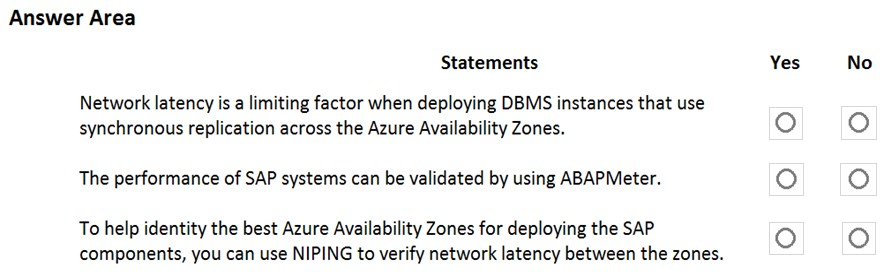
You are deploying an SAP environment across Azure Availability Zones. The environment has the following components:
✑ ASCS/ERS instances that use a failover cluster
✑ SAP application servers across the Azure Availability Zones
✑ Database high availability by using a native database solution
For each of the following statements, select Yes if the statement is true. Otherwise, select No.
NOTE: Each correct selection is worth one point.
Hot Area:
You are deploying an SAP environment across Azure Availability Zones. The environment has the following components:
✑ ASCS/ERS instances that use a failover cluster
✑ SAP application servers across the Azure Availability Zones
✑ Database high availability by using a native database solution
For each of the following statements, select Yes if the statement is true. Otherwise, select No.
NOTE: Each correct selection is worth one point.
Hot Area:

Correct Answer:
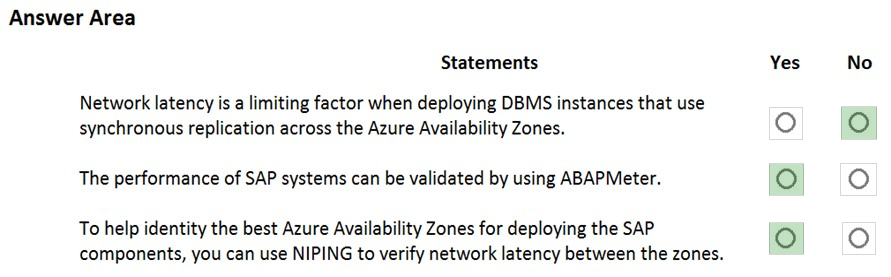
Box 1: No -
Azure Availability Zones are physically separate locations within an Azure region protecting customers' applications and data from datacenter-level failures. It is good for applications that require low-latency synchronous replication with protection from datacenter-level failures.
Box 2: Yes -
AAP application server to database server latency can be tested with ABAPMeter report /SSA/CAT.
Box 3: Yes -
To analyze network issue or measure network metrics you can test the connection using SAP's NIPING program. You can use NIPING to analyze the network connection between any two machines running SAP software.
Reference:
https://azure.microsoft.com/sv-se/blog/azure-availability-zones-expand-with-new-services-and-to-new-regions-in-europe-and-united-states/ https://azure.microsoft.com/en-us/blog/sap-on-azure-architecture-designing-for-performance-and-scalability/ https://wiki.scn.sap.com/wiki/pages/viewpage.action?pageId=360974069
Box 1: No -
Azure Availability Zones are physically separate locations within an Azure region protecting customers' applications and data from datacenter-level failures. It is good for applications that require low-latency synchronous replication with protection from datacenter-level failures.
Box 2: Yes -
AAP application server to database server latency can be tested with ABAPMeter report /SSA/CAT.
Box 3: Yes -
To analyze network issue or measure network metrics you can test the connection using SAP's NIPING program. You can use NIPING to analyze the network connection between any two machines running SAP software.
Reference:
https://azure.microsoft.com/sv-se/blog/azure-availability-zones-expand-with-new-services-and-to-new-regions-in-europe-and-united-states/ https://azure.microsoft.com/en-us/blog/sap-on-azure-architecture-designing-for-performance-and-scalability/ https://wiki.scn.sap.com/wiki/pages/viewpage.action?pageId=360974069
send
light_mode
delete
Question #32
You deploy an SAP environment on Azure.
You need to validate the load distribution to the application servers.
What should you use?
You need to validate the load distribution to the application servers.
What should you use?
- ASAPControl
- BSAP Solution Manager
- CAzure Monitor
- DSAP Web Dispatcher
Correct Answer:
D
Load balancers. These are used to distribute traffic to virtual machines in the application-tier subnet. For high availability, use the built-in SAP Web Dispatcher,
Azure Load Balancer, or network appliances, depending on the traffic type (such as HTTP or SAPGUI) or the required network services, such as Secure Sockets
Layer (SSL) termination.
Reference:
https://docs.microsoft.com/en-us/azure/architecture/reference-architectures/sap/sap-netweaver
D
Load balancers. These are used to distribute traffic to virtual machines in the application-tier subnet. For high availability, use the built-in SAP Web Dispatcher,
Azure Load Balancer, or network appliances, depending on the traffic type (such as HTTP or SAPGUI) or the required network services, such as Secure Sockets
Layer (SSL) termination.
Reference:
https://docs.microsoft.com/en-us/azure/architecture/reference-architectures/sap/sap-netweaver
send
light_mode
delete
Question #33
HOTSPOT -
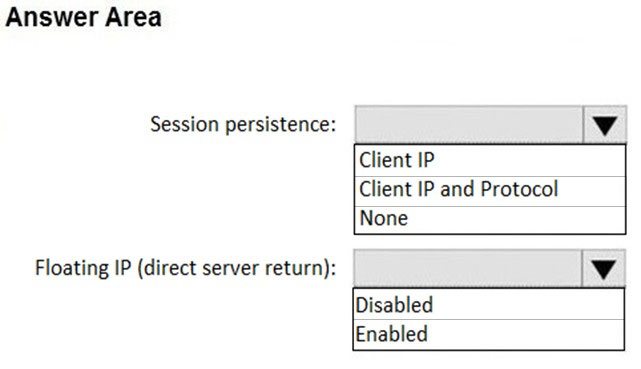
You plan to deploy a highly available ASCS instance to SUSE Linux Enterprise Server (SLES) virtual machines in Azure.
You are configuring an internal Azure Standard Load Balancer for the ASCS instance.
How should you configure the internal Standard Load Balancer? To answer, select the appropriate options in the answer area.
NOTE: Each correct selection is worth one point.
Hot Area:
You plan to deploy a highly available ASCS instance to SUSE Linux Enterprise Server (SLES) virtual machines in Azure.
You are configuring an internal Azure Standard Load Balancer for the ASCS instance.
How should you configure the internal Standard Load Balancer? To answer, select the appropriate options in the answer area.
NOTE: Each correct selection is worth one point.
Hot Area:

Correct Answer:
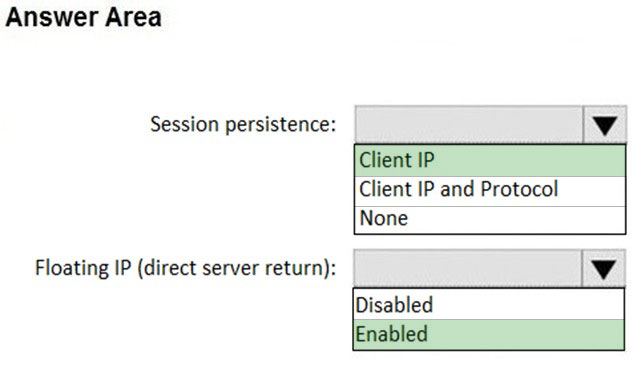
Box 1: Client IP -
The standard load balancer allows stateful sessions to remain as there are no IP address changes with this method.
Box 2: Enabled -
Make sure to enable Floating IP.
References:
https://docs.microsoft.com/en-us/azure/virtual-machines/workloads/sap/high-availability-guide-suse
Box 1: Client IP -
The standard load balancer allows stateful sessions to remain as there are no IP address changes with this method.
Box 2: Enabled -
Make sure to enable Floating IP.
References:
https://docs.microsoft.com/en-us/azure/virtual-machines/workloads/sap/high-availability-guide-suse
send
light_mode
delete
Question #34
Note: This question is part of a series of questions that present the same scenario. Each question in the series contains a unique solution that might meet the stated goals. Some question sets might have more than one correct solution, while others might not have a correct solution.
After you answer a question in this section, you will NOT be able to return to it. As a result, these questions will not appear in the review screen.
You deploy SAP HANA on Azure (Large Instances).
You need to back up the SAP HANA database to Azure.
Solution: You create a Recovery Services vault and a backup policy.
Does this meet the goal?
After you answer a question in this section, you will NOT be able to return to it. As a result, these questions will not appear in the review screen.
You deploy SAP HANA on Azure (Large Instances).
You need to back up the SAP HANA database to Azure.
Solution: You create a Recovery Services vault and a backup policy.
Does this meet the goal?
- AYes
- BNo
Correct Answer:
A
Backup architecture -
✑ The backup process begins by creating a Recovery services vault in Azure. This vault will be used to store the backups and recovery points created over time.
✑ The Azure VM running SAP HANA server is registered with the vault, and the databases to be backed-up are discovered. To enable the Azure Backup service to discover databases, a preregistration script must be run on the HANA server as a root user.
✑ This script creates AZUREWLBACKUPHANAUSER DB user and a corresponding key with the same name in hdbuserstore. Refer to the setting up permissions section to understand more about what the script does.
✑ Azure Backup Service now installs the Azure Backup Plugin for HANA on the registered SAP HANA server.
✑ The AZUREWLBACKUPHANAUSER DB user created by the preregistration script is used by the Azure Backup Plugin for HANA to perform all backup and restore operations. If you attempt to configure backup for SAP HANA DBs without running this script, you might receive the following error:
UserErrorHanaScriptNotRun.
✑ To configure backup on the databases that are discovered, choose the required backup policy and enable backups.
✑ Once the backup is configured, Azure Backup service sets up the Backint parameters at the DATABASE level on the protected SAP HANA server.
✑ The Azure Backup Plugin for HANA maintains all the backup schedules and policy details. It triggers the scheduled backups and communicates with the HANA
Backup Engine through the Backint APIs.
✑ The HANA Backup Engine returns a Backint stream with the data to be backed up.
✑ All the scheduled backups and on-demand backups (triggered from the Azure portal) that are either full or differential are initiated by the Azure Backup Plugin for HANA. However, log backups are managed and triggered by HANA Backup Engineitself.
Reference:
https://docs.microsoft.com/en-us/azure/backup/sap-hana-db-about https://docs.microsoft.com/en-us/azure/backup/backup-azure-sap-hana-database#configure-backup
A
Backup architecture -
✑ The backup process begins by creating a Recovery services vault in Azure. This vault will be used to store the backups and recovery points created over time.
✑ The Azure VM running SAP HANA server is registered with the vault, and the databases to be backed-up are discovered. To enable the Azure Backup service to discover databases, a preregistration script must be run on the HANA server as a root user.
✑ This script creates AZUREWLBACKUPHANAUSER DB user and a corresponding key with the same name in hdbuserstore. Refer to the setting up permissions section to understand more about what the script does.
✑ Azure Backup Service now installs the Azure Backup Plugin for HANA on the registered SAP HANA server.
✑ The AZUREWLBACKUPHANAUSER DB user created by the preregistration script is used by the Azure Backup Plugin for HANA to perform all backup and restore operations. If you attempt to configure backup for SAP HANA DBs without running this script, you might receive the following error:
UserErrorHanaScriptNotRun.
✑ To configure backup on the databases that are discovered, choose the required backup policy and enable backups.
✑ Once the backup is configured, Azure Backup service sets up the Backint parameters at the DATABASE level on the protected SAP HANA server.
✑ The Azure Backup Plugin for HANA maintains all the backup schedules and policy details. It triggers the scheduled backups and communicates with the HANA
Backup Engine through the Backint APIs.
✑ The HANA Backup Engine returns a Backint stream with the data to be backed up.
✑ All the scheduled backups and on-demand backups (triggered from the Azure portal) that are either full or differential are initiated by the Azure Backup Plugin for HANA. However, log backups are managed and triggered by HANA Backup Engineitself.
Reference:
https://docs.microsoft.com/en-us/azure/backup/sap-hana-db-about https://docs.microsoft.com/en-us/azure/backup/backup-azure-sap-hana-database#configure-backup
send
light_mode
delete
Question #35
HOTSPOT -
For each of the following statements, select Yes if the statement is true. Otherwise, select No.
NOTE: Each correct selection is worth one point.
Hot Area:
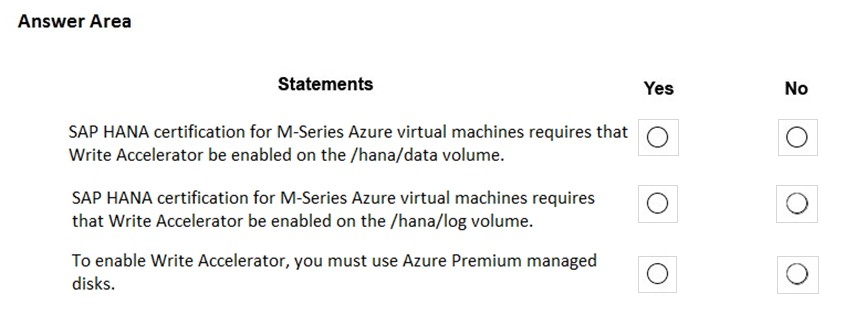
For each of the following statements, select Yes if the statement is true. Otherwise, select No.
NOTE: Each correct selection is worth one point.
Hot Area:

Correct Answer:
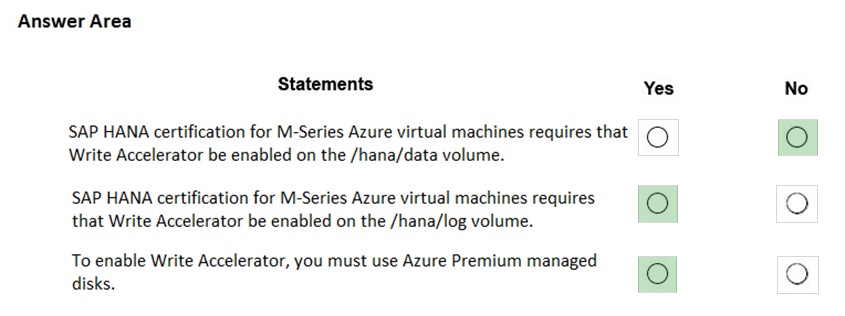
Box 1: No -
Box 2: Yes -
The minimum SAP HANA certified conditions for the different storage types are:
Azure Premium SSD - /hana/log is required to be cached with Azure Write Accelerator. The /hana/data volume could be placed on Premium SSD without Azure
Write Accelerator or on Ultra disk
Box 3: Yes -
References:
https://docs.microsoft.com/en-us/azure/virtual-machines/workloads/sap/hana-vm-operations-storage
Box 1: No -
Box 2: Yes -
The minimum SAP HANA certified conditions for the different storage types are:
Azure Premium SSD - /hana/log is required to be cached with Azure Write Accelerator. The /hana/data volume could be placed on Premium SSD without Azure
Write Accelerator or on Ultra disk
Box 3: Yes -
References:
https://docs.microsoft.com/en-us/azure/virtual-machines/workloads/sap/hana-vm-operations-storage
send
light_mode
delete
Question #36
You have an Azure subscription.
You deploy Active Directory domain controllers to Azure virtual machines.
You plan to deploy Azure for SAP workloads.
You plan to segregate the domain controllers from the SAP systems by using different virtual networks.
You need to recommend a solution to connect the virtual networks. The solution must minimize costs.
What should you recommend?
You deploy Active Directory domain controllers to Azure virtual machines.
You plan to deploy Azure for SAP workloads.
You plan to segregate the domain controllers from the SAP systems by using different virtual networks.
You need to recommend a solution to connect the virtual networks. The solution must minimize costs.
What should you recommend?
- Aa site-to-site VPN
- Bvirtual network peeringMost Voted
- Cuser-defined routing
- DExpressRoute
Correct Answer:
C
You can create custom, or user-defined, routes in Azure to override Azure's default system routes, or to add additional routes to a subnet's route table. In Azure, you create a route table, then associate the route table to zero or more virtual network subnets.
Incorrect Answers:
D: ExpressRoute is a costly solution.
C
You can create custom, or user-defined, routes in Azure to override Azure's default system routes, or to add additional routes to a subnet's route table. In Azure, you create a route table, then associate the route table to zero or more virtual network subnets.
Incorrect Answers:
D: ExpressRoute is a costly solution.
send
light_mode
delete
Question #37
You deploy an SAP environment on Azure.
Your company has a Service Level Agreement (SLA) of 99.99% for SAP.
You implement Azure Availability Zones that have the following components:
✑ Redundant SAP application servers
✑ ASCS/ERS instances that use a failover cluster
Database high availability that has a primary instance and a secondary instance

You need to validate the high availability configuration of the ASCS/ERS cluster.
What should you use?
Your company has a Service Level Agreement (SLA) of 99.99% for SAP.
You implement Azure Availability Zones that have the following components:
✑ Redundant SAP application servers
✑ ASCS/ERS instances that use a failover cluster
Database high availability that has a primary instance and a secondary instance

You need to validate the high availability configuration of the ASCS/ERS cluster.
What should you use?
- ASAP Web Dispatcher
- BAzure Traffic Manager
- CSAPControlMost Voted
- DSAP Solution Manager
send
light_mode
delete
Question #38
DRAG DROP -
You are validating an SAP HANA on Azure (Large Instances) deployment.
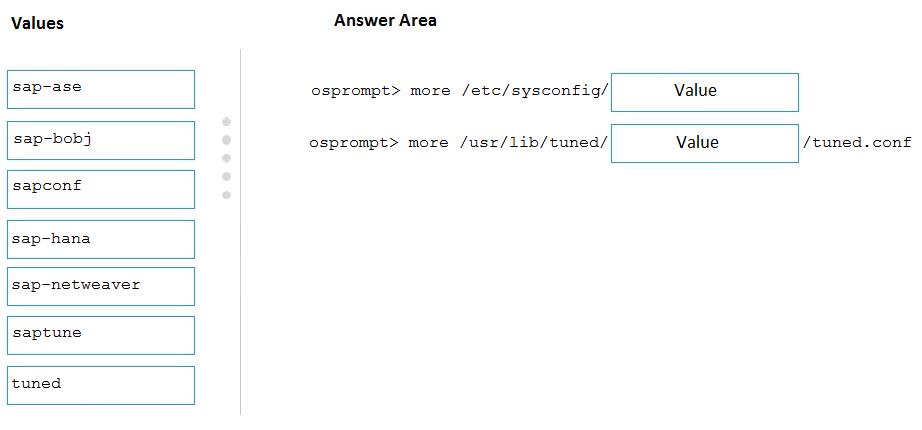
You need to ensure that sapconf is installed and the kernel parameters are set appropriately for the active profile.
How should you complete the commands? To answer, drag the appropriate values to the correct targets. Each value may be used once, more than once, or not at all. You may need to drag the split bar between panes or scroll to view content.
NOTE: Each correct selection is worth one point.
Select and Place:
You are validating an SAP HANA on Azure (Large Instances) deployment.
You need to ensure that sapconf is installed and the kernel parameters are set appropriately for the active profile.
How should you complete the commands? To answer, drag the appropriate values to the correct targets. Each value may be used once, more than once, or not at all. You may need to drag the split bar between panes or scroll to view content.
NOTE: Each correct selection is worth one point.
Select and Place:

Correct Answer:
Box 1: sapconf -
The configuration is split into two parts:
/etc/sysconfig/sapconf
/usr/lib/tuned//tuned.conf
Box 2: tuned -
References:
https://www.suse.com/c/sapconf-a-way-to-prepare-a-sles-system-for-sap-workload-part-2/
Box 1: sapconf -
The configuration is split into two parts:
/etc/sysconfig/sapconf
/usr/lib/tuned//tuned.conf
Box 2: tuned -
References:
https://www.suse.com/c/sapconf-a-way-to-prepare-a-sles-system-for-sap-workload-part-2/
send
light_mode
delete
Question #39
You are deploying an SAP environment on Azure that will use an SAP HANA database server.
You provision an Azure virtual machine for SAP HANA by using the M64s virtual machine SKU.
You need to set the swap space by using the Microsoft Azure Linux Agent (waagent) configuration file.
Which two settings should you configure? Each correct answer presents part of the solution.
NOTE: Each correct selection is worth one point.
You provision an Azure virtual machine for SAP HANA by using the M64s virtual machine SKU.
You need to set the swap space by using the Microsoft Azure Linux Agent (waagent) configuration file.
Which two settings should you configure? Each correct answer presents part of the solution.
NOTE: Each correct selection is worth one point.
- AResourceDisk.EnableSwapEncryption=n
- BAutoUpdate.Enabled=n
- CResourceDisk.SwapSizeMB=229376Most Voted
- DResourceDisk.EnableSwap=yMost Voted
Correct Answer:
CD
To create a swap file in the directory that's defined by the ResourceDisk.MountPoint parameter, you can update the /etc/waagent.conf file by setting the following three parameters:
ResourceDisk.Format=y -
ResourceDisk.EnableSwap=y -
ResourceDisk.SwapSizeMB=xx -
Reference:
https://support.microsoft.com/en-us/help/4010058/how-to-add-a-swap-file-in-linux-azure-virtual-machines
CD
To create a swap file in the directory that's defined by the ResourceDisk.MountPoint parameter, you can update the /etc/waagent.conf file by setting the following three parameters:
ResourceDisk.Format=y -
ResourceDisk.EnableSwap=y -
ResourceDisk.SwapSizeMB=xx -
Reference:
https://support.microsoft.com/en-us/help/4010058/how-to-add-a-swap-file-in-linux-azure-virtual-machines
send
light_mode
delete
Question #40
HOTSPOT -
You have the following Azure Resource Manager template.

For each of the following statements, select Yes if the statement is true. Otherwise, select No.
NOTE: Each correct selection is worth one point.
Hot Area:
You have the following Azure Resource Manager template.

For each of the following statements, select Yes if the statement is true. Otherwise, select No.
NOTE: Each correct selection is worth one point.
Hot Area:

Correct Answer:
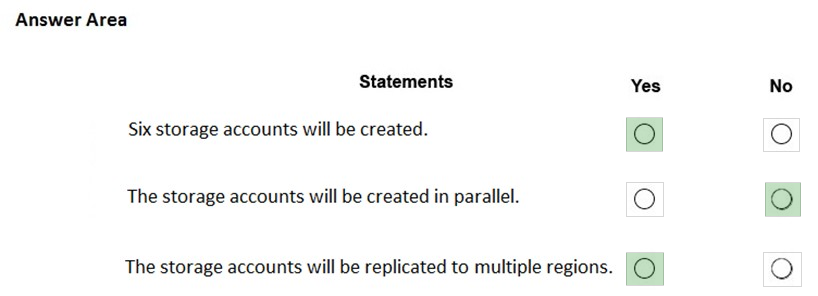
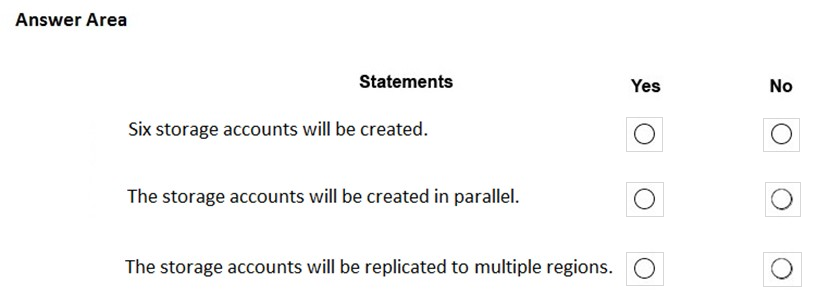
Box 1: Yes -
Count is 6.
Box 2: No -
Mode is serial.
Box 3: Yes -
Reference:
https://docs.microsoft.com/en-us/azure/azure-resource-manager/templates/copy-resources
Box 1: Yes -
Count is 6.
Box 2: No -
Mode is serial.
Box 3: Yes -
Reference:
https://docs.microsoft.com/en-us/azure/azure-resource-manager/templates/copy-resources
send
light_mode
delete
All Pages
