


Microsoft AZ-120 Exam Practice Questions (P. 3)
- Full Access (414 questions)
- One Year of Premium Access
- Access to one million comments
- Seamless ChatGPT Integration
- Ability to download PDF files
- Anki Flashcard files for revision
- No Captcha & No AdSense
- Advanced Exam Configuration
Question #21
HOTSPOT -
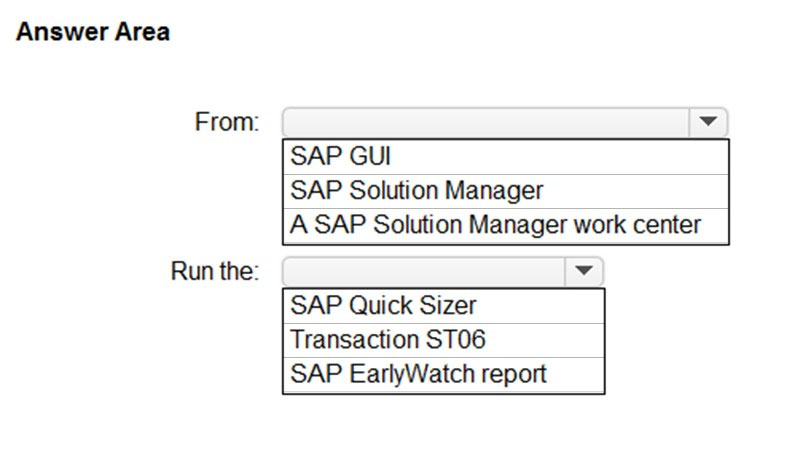
You have an on-premises deployment of SAP HANA.
You plan to migrate the deployment to Azure.
You need to identify the following from the last six months:
✑ The number of active users
✑ The database performance
What should you do? To answer, select the appropriate options in the answer area.
NOTE: Each correct selection is worth one point.
Hot Area:
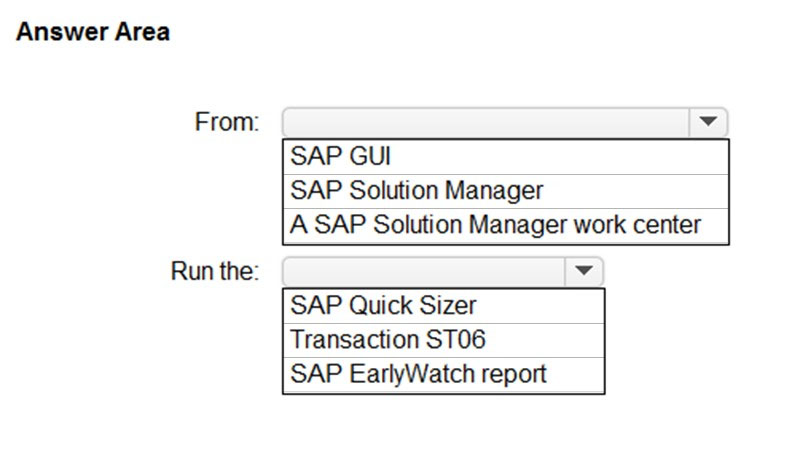
You have an on-premises deployment of SAP HANA.
You plan to migrate the deployment to Azure.
You need to identify the following from the last six months:
✑ The number of active users
✑ The database performance
What should you do? To answer, select the appropriate options in the answer area.
NOTE: Each correct selection is worth one point.
Hot Area:
Correct Answer:
Reference:
https://assets.cdn.sap.com/sapcom/docs/2019/09/0e8d0628-687d-0010-87a3-c30de2ffd8ff.pdf
Reference:
https://assets.cdn.sap.com/sapcom/docs/2019/09/0e8d0628-687d-0010-87a3-c30de2ffd8ff.pdf
Question #23
HOTSPOT -
You have an Azure Availability Set that is configured as shown in the following exhibit.
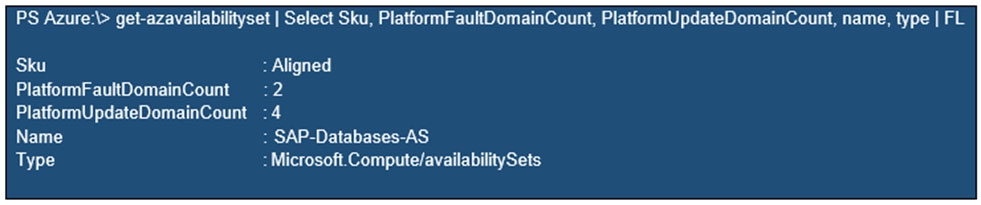
Use the drop-down menus to select the answer choice that completes each statement based on the information presented in the graphic.
NOTE: Each correct selection is worth one point.
Hot Area:
You have an Azure Availability Set that is configured as shown in the following exhibit.
Use the drop-down menus to select the answer choice that completes each statement based on the information presented in the graphic.
NOTE: Each correct selection is worth one point.
Hot Area:
Correct Answer:
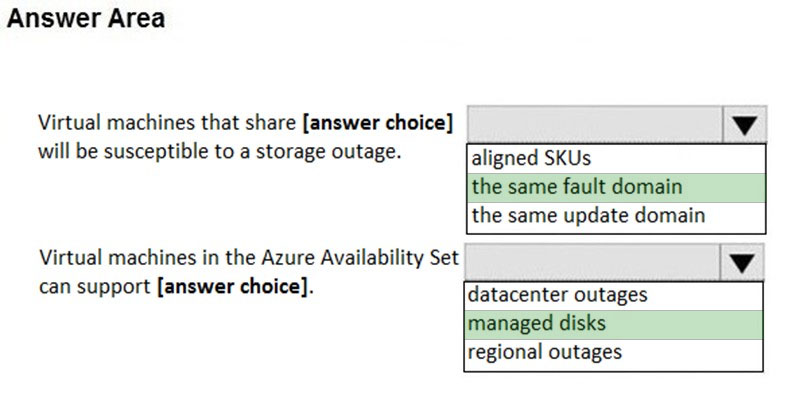
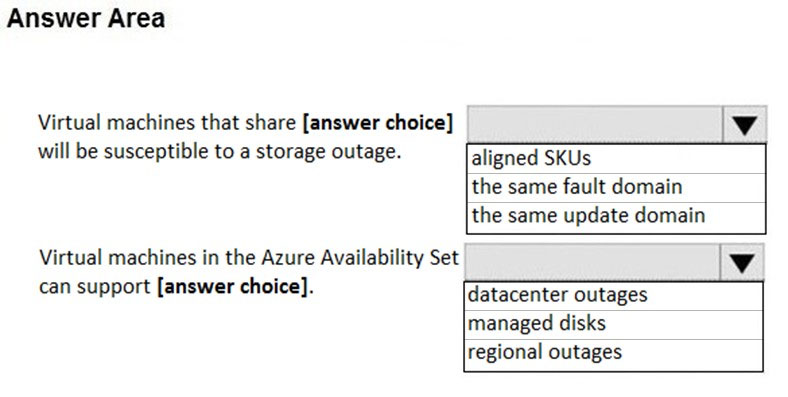
Box 1: the same fault domain -
Fault domains define the group of virtual machines that share a common power source and network switch. If a storage fault domain fails due to hardware or software failure, only the VM instance with disks on the storage fault domain fails.
Box 2: managed disks -
Managed disks provide better reliability for Availability Sets by ensuring that the disks of VMs in an Availability Set are sufficiently isolated from each other to avoid single points of failure. It does this by automatically placing the disks in different storage fault domains (storage clusters) and aligning them with the VM fault domain.
References:
https://docs.microsoft.com/en-us/azure/virtual-machines/windows/manage-availability
Box 1: the same fault domain -
Fault domains define the group of virtual machines that share a common power source and network switch. If a storage fault domain fails due to hardware or software failure, only the VM instance with disks on the storage fault domain fails.
Box 2: managed disks -
Managed disks provide better reliability for Availability Sets by ensuring that the disks of VMs in an Availability Set are sufficiently isolated from each other to avoid single points of failure. It does this by automatically placing the disks in different storage fault domains (storage clusters) and aligning them with the VM fault domain.
References:
https://docs.microsoft.com/en-us/azure/virtual-machines/windows/manage-availability
Question #26
You have an Azure subscription.
Your company has an SAP environment that runs on SUSE Linux Enterprise Server (SLES) servers and SAP HANA. The environment has a primary site and a disaster recovery site. Disaster recovery is based on SAP HANA system replication. The SAP ERP environment is 4 TB and has a projected growth of 5% per month.
The company has an uptime Service Level Agreement (SLA) of 99.99%, a maximum recovery time objective (RTO) of four hours, and a recovery point objective
(RPO) of 10 minutes.
You plan to migrate to Azure.
You need to design an SAP landscape for the company.
Which options meet the company's requirements?
A.
✑ Azure virtual machines and SLES for SAP application servers
✑ SAP HANA on Azure (Large Instances) that uses SAP HANA system replication for high availability and disaster recovery
B.
✑ ASCS/ERS and SLES clustering that uses the Pacemaker fence agent
✑ SAP application servers deployed to an Azure Availability Zone
✑ SAP HANA on Azure (Large Instances) that uses SAP HANA system replication for database high availability and disaster recovery
C.
✑ SAP application instances deployed to an Azure Availability Set
✑ SAP HANA on Azure (Large Instances) that uses SAP HANA system replication for database high availability and disaster recovery
D.
✑ ASCS/ERS and SLES clustering that uses the Azure fence agent
SAP application servers deployed to an Azure Availability Set

✑ SAP HANA on Azure (Large Instances) that uses SAP HANA system replication for database high availability and disaster recovery
Your company has an SAP environment that runs on SUSE Linux Enterprise Server (SLES) servers and SAP HANA. The environment has a primary site and a disaster recovery site. Disaster recovery is based on SAP HANA system replication. The SAP ERP environment is 4 TB and has a projected growth of 5% per month.
The company has an uptime Service Level Agreement (SLA) of 99.99%, a maximum recovery time objective (RTO) of four hours, and a recovery point objective
(RPO) of 10 minutes.
You plan to migrate to Azure.
You need to design an SAP landscape for the company.
Which options meet the company's requirements?
A.
✑ Azure virtual machines and SLES for SAP application servers
✑ SAP HANA on Azure (Large Instances) that uses SAP HANA system replication for high availability and disaster recovery
B.
✑ ASCS/ERS and SLES clustering that uses the Pacemaker fence agent
✑ SAP application servers deployed to an Azure Availability Zone
✑ SAP HANA on Azure (Large Instances) that uses SAP HANA system replication for database high availability and disaster recovery
C.
✑ SAP application instances deployed to an Azure Availability Set
✑ SAP HANA on Azure (Large Instances) that uses SAP HANA system replication for database high availability and disaster recovery
D.
✑ ASCS/ERS and SLES clustering that uses the Azure fence agent
SAP application servers deployed to an Azure Availability Set
✑ SAP HANA on Azure (Large Instances) that uses SAP HANA system replication for database high availability and disaster recovery
Question #27
DRAG DROP -
Your on-premises network contains an Active Directory domain.
You have an SAP environment on Azure that runs on SUSE Linux Enterprise Server (SLES) servers.
You configure the SLES servers to use domain controllers as their NTP servers and their DNS servers.
You need to join the SLES servers to the Active Directory domain.
Which three actions should you perform in sequence? To answer, move the appropriate actions from the list of actions to the answer area and arrange them in the correct order.
Select and Place:
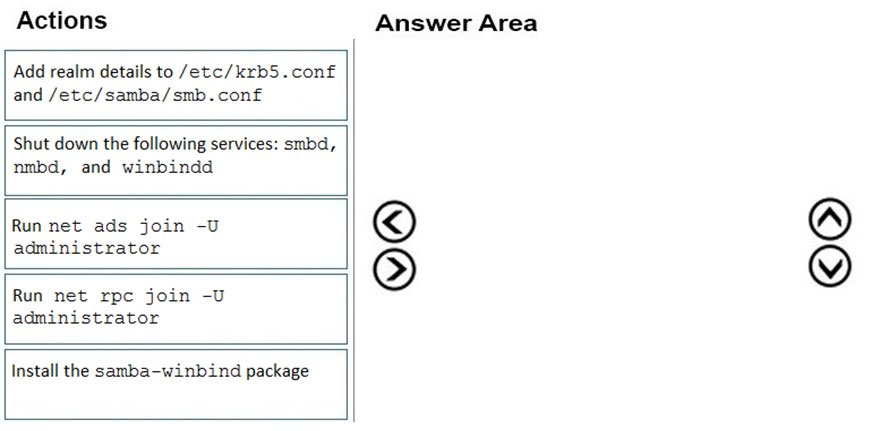
Your on-premises network contains an Active Directory domain.
You have an SAP environment on Azure that runs on SUSE Linux Enterprise Server (SLES) servers.
You configure the SLES servers to use domain controllers as their NTP servers and their DNS servers.
You need to join the SLES servers to the Active Directory domain.
Which three actions should you perform in sequence? To answer, move the appropriate actions from the list of actions to the answer area and arrange them in the correct order.
Select and Place:
Correct Answer:
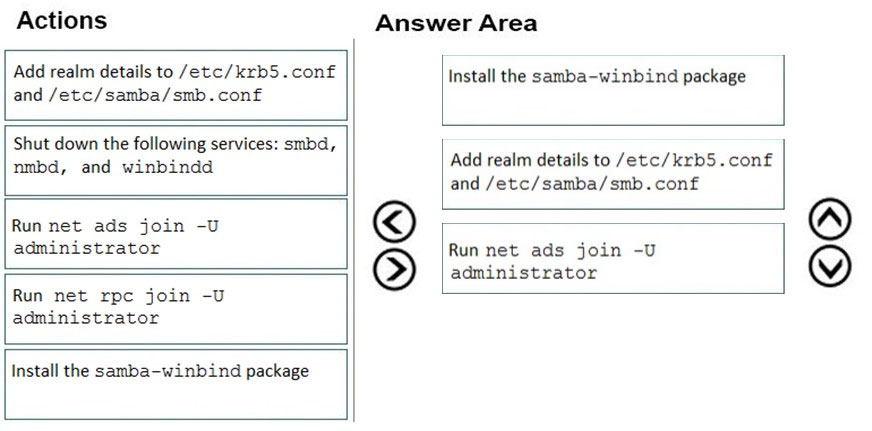
Step 1: Install the samba-winbind package
Install samba-winbind -
Step 2: Add realm details to /etc/krb5.conf and /etc/samba/smb.conf
Edit files - best way to do this is to use yast on test machine and copy files from it
In following examples you need to replace EXAMPLE/EXAMPLE.COM/.example.com with your values/settings
/etc/samba/smb.conf
[global]
workgroup = EXAMPLE
usershare allow guests = NO #disallow guests from sharing
idmap gid = 10000-20000
idmap uid = 10000-20000
kerberos method = secrets and keytab
realm = EXAMPLE.COM
security = ADS
template homedir = /home/%D/%U
template shell = /bin/bash
winbind offline logon = yes
winbind refresh tickets = yes
/etc/krb5.conf
[libdefaults]
default_realm = EXAMPLE.COM
clockskew = 300
[realms]
EXAMPLE.COM = {
kdc = PDC.EXAMPLE.COM
default_domain = EXAMPLE.COM
admin_server = PDC.EXAMPLE.COM
}
..
Step 3: Run net ads join -U administrator
Join the SLES 12 Server to the AD domain
References:
https://www.suse.com/support/kb/doc/?id=7018461
Step 1: Install the samba-winbind package
Install samba-winbind -
Step 2: Add realm details to /etc/krb5.conf and /etc/samba/smb.conf
Edit files - best way to do this is to use yast on test machine and copy files from it
In following examples you need to replace EXAMPLE/EXAMPLE.COM/.example.com with your values/settings
/etc/samba/smb.conf
[global]
workgroup = EXAMPLE
usershare allow guests = NO #disallow guests from sharing
idmap gid = 10000-20000
idmap uid = 10000-20000
kerberos method = secrets and keytab
realm = EXAMPLE.COM
security = ADS
template homedir = /home/%D/%U
template shell = /bin/bash
winbind offline logon = yes
winbind refresh tickets = yes
/etc/krb5.conf
[libdefaults]
default_realm = EXAMPLE.COM
clockskew = 300
[realms]
EXAMPLE.COM = {
kdc = PDC.EXAMPLE.COM
default_domain = EXAMPLE.COM
admin_server = PDC.EXAMPLE.COM
}
..
Step 3: Run net ads join -U administrator
Join the SLES 12 Server to the AD domain
References:
https://www.suse.com/support/kb/doc/?id=7018461
Question #30
HOTSPOT -
You have SAP ERP on Azure.
For SAP high availability, you plan to deploy ASCS/ERS instances across Azure Availability Zones and to use failover clusters.
For each of the following statements, select Yes if the statement is true. Otherwise, select No.
NOTE: Each correct selection is worth one point.
Hot Area:
You have SAP ERP on Azure.
For SAP high availability, you plan to deploy ASCS/ERS instances across Azure Availability Zones and to use failover clusters.
For each of the following statements, select Yes if the statement is true. Otherwise, select No.
NOTE: Each correct selection is worth one point.
Hot Area:
Correct Answer:
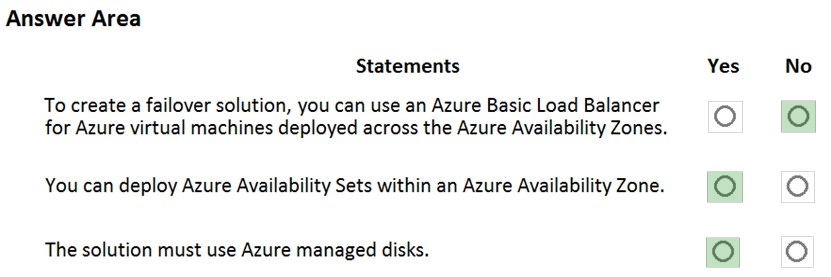
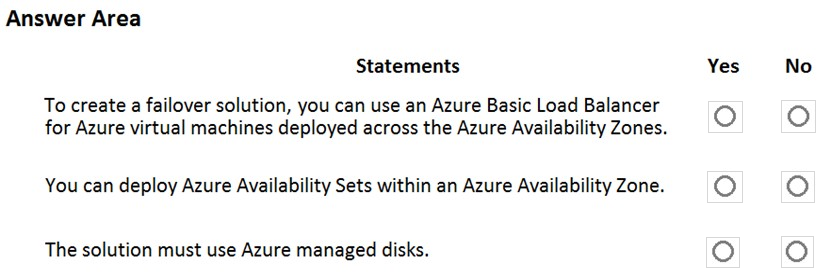
Box 1: No -
You can't use an Azure Basic Load Balancer to create failover cluster solutions based on Windows Server Failover Clustering or Linux Pacemaker. Instead, you need to use the Azure Standard Load Balancer SKU.
Box 2: Yes -
Azure Availability Zones is one of the high-availability features that Azure provides. Using Availability Zones improves the overall availability of SAP workloads on
Azure.
The SAP application layer is deployed across one Azure availability set. For high availability of SAP Central Services, you can deploy two VMs in a separate availability set.
Box 3: Yes -
You must use Azure Managed Disks when you deploy to Azure Availability Zones.
Reference:
https://docs.microsoft.com/en-us/azure/virtual-machines/workloads/sap/sap-ha-availability-zones
Box 1: No -
You can't use an Azure Basic Load Balancer to create failover cluster solutions based on Windows Server Failover Clustering or Linux Pacemaker. Instead, you need to use the Azure Standard Load Balancer SKU.
Box 2: Yes -
Azure Availability Zones is one of the high-availability features that Azure provides. Using Availability Zones improves the overall availability of SAP workloads on
Azure.
The SAP application layer is deployed across one Azure availability set. For high availability of SAP Central Services, you can deploy two VMs in a separate availability set.
Box 3: Yes -
You must use Azure Managed Disks when you deploy to Azure Availability Zones.
Reference:
https://docs.microsoft.com/en-us/azure/virtual-machines/workloads/sap/sap-ha-availability-zones
All Pages