


Cisco® 200-310 Exam Practice Questions (P. 5)
- Full Access (776 questions)
- One Year of Premium Access
- Access to one million comments
- Seamless ChatGPT Integration
- Ability to download PDF files
- Anki Flashcard files for revision
- No Captcha & No AdSense
- Advanced Exam Configuration
Question #41
DRAG DROP -
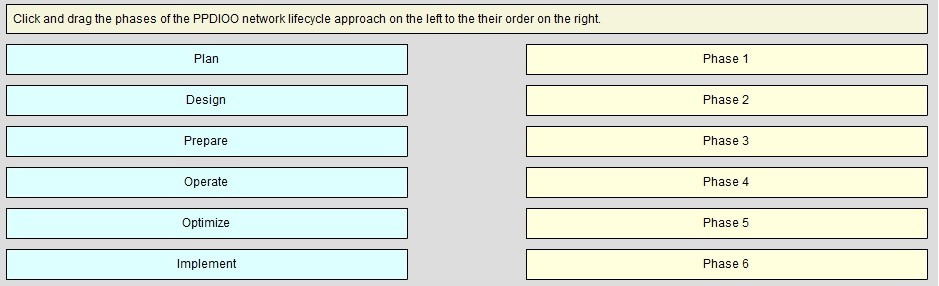
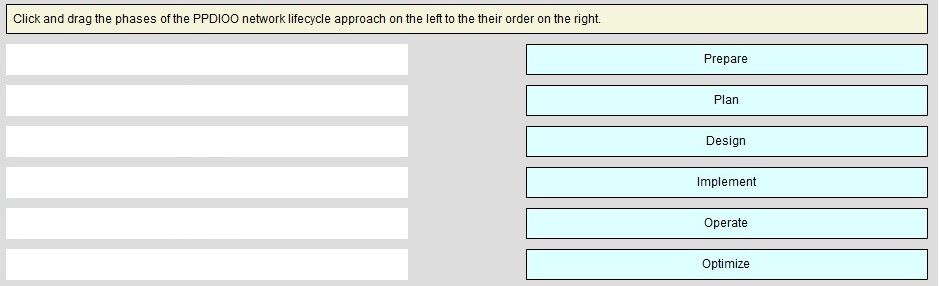
Click and drag the phases of the PPDIOO network lifecycle approach on the left to their order on the right.
Select and Place:
Click and drag the phases of the PPDIOO network lifecycle approach on the left to their order on the right.
Select and Place:
Question #44
Refer to the exhibit.
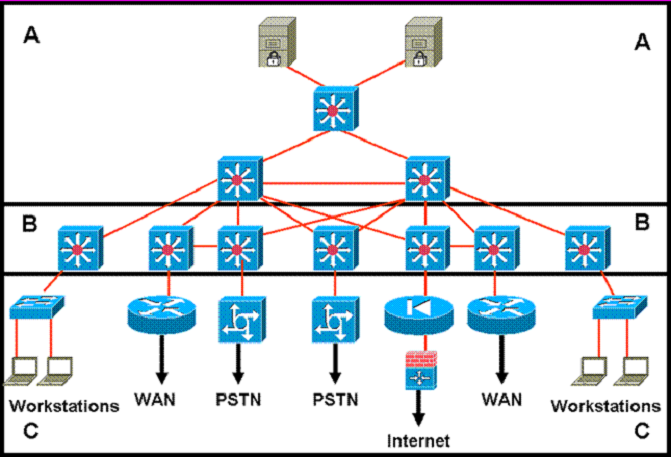
Which statement accurately represents the characteristics of the core layer in this design?
Which statement accurately represents the characteristics of the core layer in this design?
Question #46
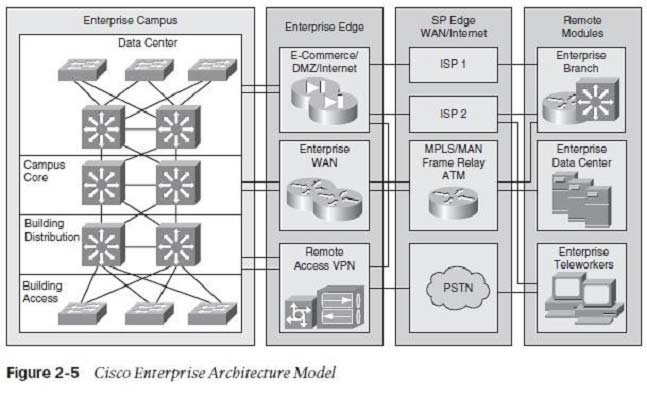
Which three modular components are part of the Cisco Enterprise Edge Architecture? (Choose three.)
- Ae-commerce module
- BInternet connectivity module
- Cserver farm module
- Dremote access and VPN module
- EPSTN services module
- Fenterprise branch module
- Gbuilding distribution module
Correct Answer:
ABD
ABD
Question #49
DRAG DROP -
Drag the characteristics of the traditional campus network on the left to the most appropriate hierarchical network layer on the right.
Select and Place:
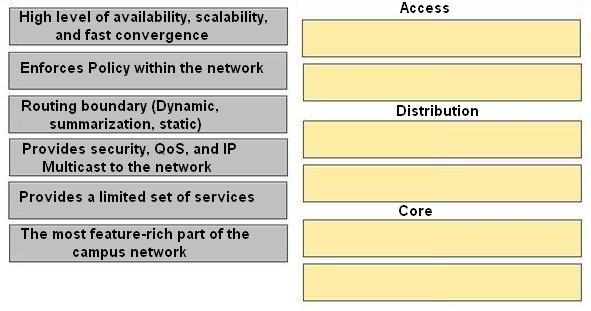
Drag the characteristics of the traditional campus network on the left to the most appropriate hierarchical network layer on the right.
Select and Place:
Correct Answer:
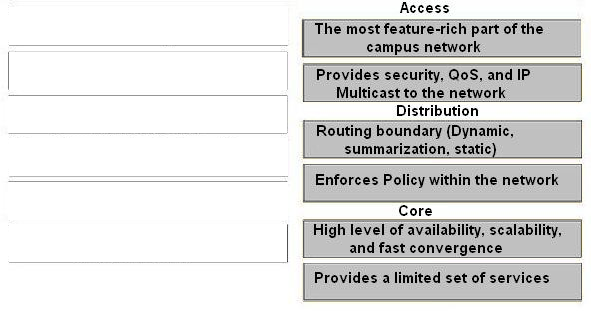
Access -
✑ The most feature-rich part of the campus network
✑ Provides security, QoS, and IP Multicast to the network
Distribution -
✑ Routing boundary (Dynamic, summarization, static)
✑ Enforces Policy within the network
Core -
✑ High level of availability, scalability, and fast convergence
✑ Provides a limited set of services
Large-Building LANs -
Large-building LANs are segmented by floors or departments. The building-access component serves one or more departments or floors. The building-distribution component serves one or more building-access components. Campus and building backbone devices connect the data center, building-distribution components, and the enterprise edge-distribution component. The access layer typically uses Layer 2 switches to contain costs, with more expensive Layer 3 switches in the distribution layer to provide policy enforcement. Current best practice is to also deploy multilayer switches in the campus and building backbone.
Cisco Enterprise Architecture Model
Core -
✑ Fast transport
✑ High reliability
✑ Redundancy
✑ Fault tolerance
✑ Low latency and good manageability
✑ Avoidance of slow packet manipulation caused by filters or other processes
✑ Limited and consistent diameter
✑ Quality of service (QoS)
Distribution -
✑ Policy-based connectivity
✑ Redundancy and load balancing
✑ Aggregation of LAN wiring closets
✑ Aggregation of WAN connections
✑ QoS
✑ Security filtering
✑ Address or area aggregation or summarization
✑ Departmental or workgroup access
✑ Broadcast or multicast domain definition
✑ Routing between virtual LANs (VLAN)
✑ Media translations (for example, between Ethernet and Token Ring)
✑ Redistribution between routing domains (for example, between two different routing protocols)
✑ Demarcation between static and dynamic routing protocols
Access -
✑ Layer 2 switching
✑ High availability
✑ Port security
✑ Broadcast suppression
✑ QoS
✑ Rate limiting
✑ Address Resolution Protocol (ARP) inspection
✑ Virtual access control lists (VACL)
✑ Spanning tree
✑ Trust classification
Power over Ethernet (PoE) and auxiliary VLANs for VoIP
Cisco Press CCDA 640-864 Official Certification Guide Fourth Edition, Chapter 3
Access -
✑ The most feature-rich part of the campus network
✑ Provides security, QoS, and IP Multicast to the network
Distribution -
✑ Routing boundary (Dynamic, summarization, static)
✑ Enforces Policy within the network
Core -
✑ High level of availability, scalability, and fast convergence
✑ Provides a limited set of services
Large-Building LANs -
Large-building LANs are segmented by floors or departments. The building-access component serves one or more departments or floors. The building-distribution component serves one or more building-access components. Campus and building backbone devices connect the data center, building-distribution components, and the enterprise edge-distribution component. The access layer typically uses Layer 2 switches to contain costs, with more expensive Layer 3 switches in the distribution layer to provide policy enforcement. Current best practice is to also deploy multilayer switches in the campus and building backbone.
Cisco Enterprise Architecture Model
Core -
✑ Fast transport
✑ High reliability
✑ Redundancy
✑ Fault tolerance
✑ Low latency and good manageability
✑ Avoidance of slow packet manipulation caused by filters or other processes
✑ Limited and consistent diameter
✑ Quality of service (QoS)
Distribution -
✑ Policy-based connectivity
✑ Redundancy and load balancing
✑ Aggregation of LAN wiring closets
✑ Aggregation of WAN connections
✑ QoS
✑ Security filtering
✑ Address or area aggregation or summarization
✑ Departmental or workgroup access
✑ Broadcast or multicast domain definition
✑ Routing between virtual LANs (VLAN)
✑ Media translations (for example, between Ethernet and Token Ring)
✑ Redistribution between routing domains (for example, between two different routing protocols)
✑ Demarcation between static and dynamic routing protocols
Access -
✑ Layer 2 switching
✑ High availability
✑ Port security
✑ Broadcast suppression
✑ QoS
✑ Rate limiting
✑ Address Resolution Protocol (ARP) inspection
✑ Virtual access control lists (VACL)
✑ Spanning tree
✑ Trust classification
Power over Ethernet (PoE) and auxiliary VLANs for VoIP
Cisco Press CCDA 640-864 Official Certification Guide Fourth Edition, Chapter 3
Question #50
DRAG DROP -
Drag the network function on the left to the functional area or module where it is most likely to be performed in the enterprise campus infrastructure on the right.
Select and Place:
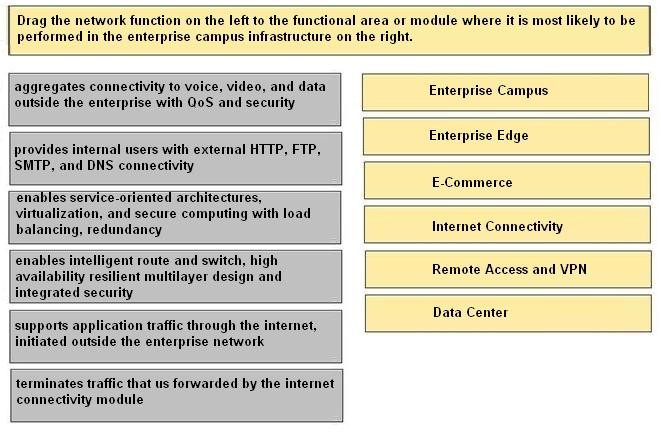
Drag the network function on the left to the functional area or module where it is most likely to be performed in the enterprise campus infrastructure on the right.
Select and Place:
Correct Answer:
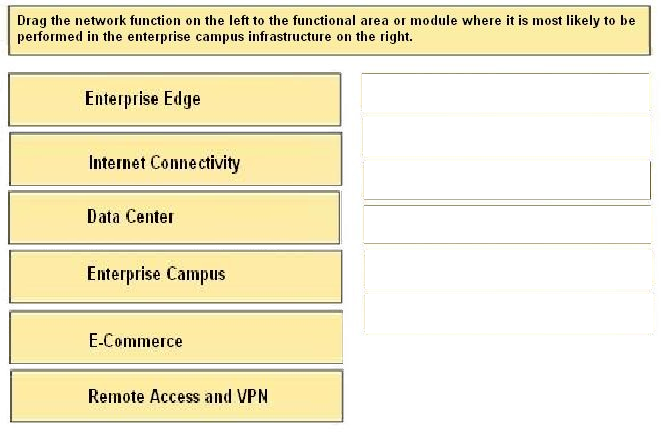
1 Enterprise Edge
2 Internet Connectivity
3 Data Center
4 Enterprise Campus
5 E-Commerce
6 Remote Access and VPN
please refer to link.
Link: http://www.cisco.com/en/US/docs/solutions/Enterprise/Campus/campover.html#wp708979
CCDA Study Guide: Diane Teare
1 Enterprise Edge
2 Internet Connectivity
3 Data Center
4 Enterprise Campus
5 E-Commerce
6 Remote Access and VPN
please refer to link.
Link: http://www.cisco.com/en/US/docs/solutions/Enterprise/Campus/campover.html#wp708979
CCDA Study Guide: Diane Teare
All Pages