Salesforce Certified MuleSoft Developer II Exam Practice Questions (P. 2)
- Full Access (57 questions)
- One Year of Premium Access
- Access to one million comments
- Seamless ChatGPT Integration
- Ability to download PDF files
- Anki Flashcard files for revision
- No Captcha & No AdSense
- Advanced Exam Configuration
Question #6
An order processing system is composed of multiple Mule applications responsible for warehouse, sales, and shipping. Each application communicates using Anypoint MQ. Each message must be correlated against the original order ID for observability and tracing.
How should a developer propagate the order ID as the correlation ID across each message?
- AUse the underlying HTTP request of Anypoint MQ to set the "X-CORRELATION-ID" header to the order ID
- BWrap all Anypoint MQ Publish operations within a With CorrelationID scope from the Tracing module, setting the correlation ID to the order ID
- CSet a custom Anypoint MQ user property to propagate the order ID and set the correlation ID in the receiving applications
- DUse the default correlation ID; Anypoint MQ will automatically propagate it
send
light_mode
delete
Question #7
The Center for Enablement team published a common application as a reusable module to the central Nexus repository.
How can the common application be included in all API implementation?
- AAdd a Maven dependency in the POM file with mule-plugin as <classifier>
- BAdd a Maven dependency in the POM file with jar as <classifier>
- CCopy the common application's source XML file and put it in a new flow file in the src/main/mule folder
- DDownload the common application from Nexus and copy it to the src/main/resources folder in the API
send
light_mode
delete
Question #8
Refer to the exhibits.

A Mule application contains two policies: Policy A and Policy B. Policy A has order 1, and Policy B has order 2. Policy A, Policy B, and a flow are defined by the configurations below.
When an HTTP request arrives at the Mule application's endpoint, what will be the execution order?

A Mule application contains two policies: Policy A and Policy B. Policy A has order 1, and Policy B has order 2. Policy A, Policy B, and a flow are defined by the configurations below.
When an HTTP request arrives at the Mule application's endpoint, what will be the execution order?
- AB1, A1, F1, A2, B2
- BF1, B1, A1, A2, B2
- CA1, B1, F1, B2, A2
- DF1, A1, B1, B2, A2
send
light_mode
delete
Question #9
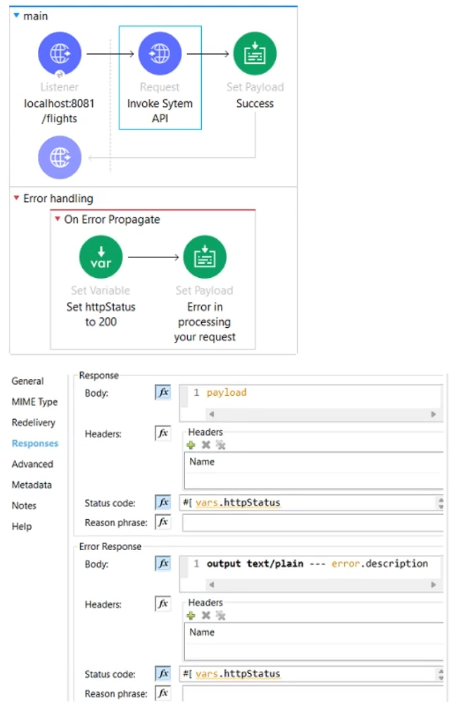
Refer to the exhibits.

The HTTP Request operation raises an HTTP:CONNECTIVITY error.
Which HTTP status code and body are returned to the web client?

The HTTP Request operation raises an HTTP:CONNECTIVITY error.
Which HTTP status code and body are returned to the web client?
- AHTTP Status Code: 200.
Body: The HTTP:CONNECTIVITY Error description. - BHTTP Status Code: 500.
Body: The HTTP:CONNECTIVITY Error description. - CHTTP Status Code: 500.
Body: "Error in processing your request". - DHTTP Status Code: 200.
Body: "Error in processing your request".
send
light_mode
delete
Question #10
A scatter-gather router is configured with four routes: Route A, B, C and D.
Route C fails.
Which expression allows access to the failing route so that it can be compensated?
Route C fails.
Which expression allows access to the failing route so that it can be compensated?
- Apayload['2']
- Berror.errorMessage.payload.failures['2']
- Cerror.errorMessage.payload.results['2']
- Dpayload.failures['2']
send
light_mode
delete
All Pages