


Microsoft AZ-800 Exam Practice Questions (P. 3)
- Full Access (305 questions)
- One Year of Premium Access
- Access to one million comments
- Seamless ChatGPT Integration
- Ability to download PDF files
- Anki Flashcard files for revision
- No Captcha & No AdSense
- Advanced Exam Configuration
Question #21
HOTSPOT -
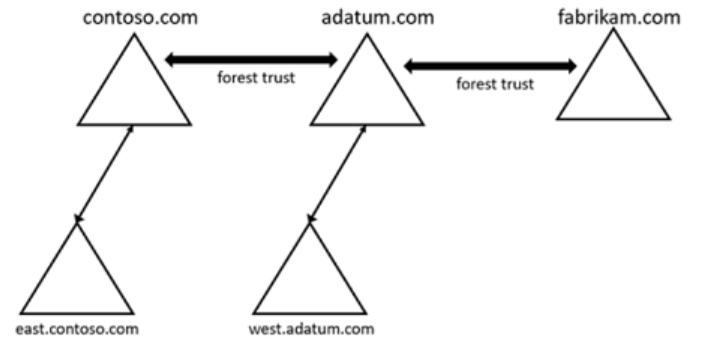
Your network contains three Active Directory Domain Services (AD DS) forests as shown in the following exhibit.
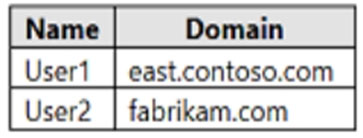
The network contains the users shown in the following table.
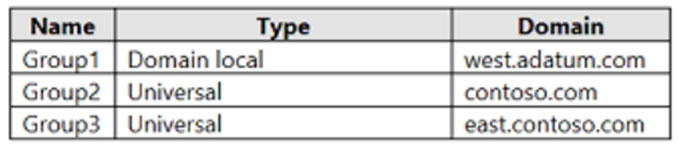
The network contains the security groups shown in the following table.
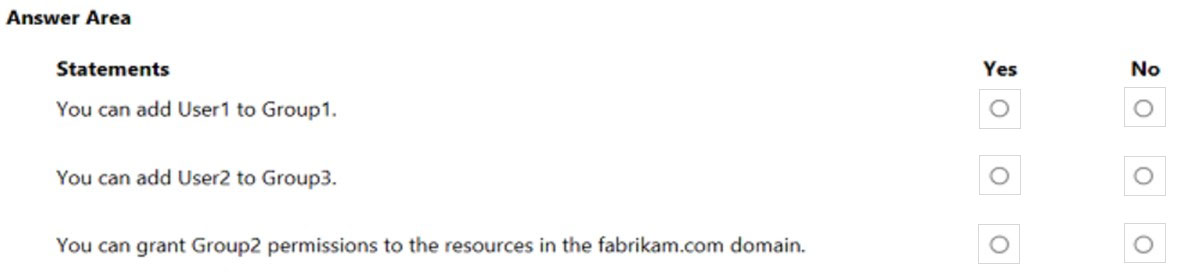
For each of the following statements, select Yes if the statement is true. Otherwise. select No.
NOTE: Each correct selection is worth one point.
Hot Area:
Your network contains three Active Directory Domain Services (AD DS) forests as shown in the following exhibit.
The network contains the users shown in the following table.
The network contains the security groups shown in the following table.
For each of the following statements, select Yes if the statement is true. Otherwise. select No.
NOTE: Each correct selection is worth one point.
Hot Area:
Correct Answer:
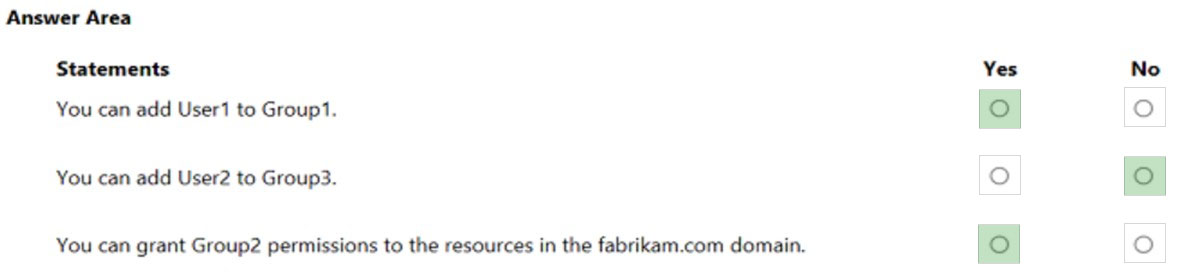
Box 1: Yes -
User1 is in east.contoso.com. Group1 is Domain Local group in west.adutm.com.
Accounts from any domain or any trusted domain Global groups from any domain or any trusted domain can be members of Domain Local groups.
Accounts, Global groups, and Universal groups from other forests and from external domains can also be members of Domain Local groups.
Box 2: No -
User2 is in the fabrikam.com domain.
Group3 is a Universal group in east.contso.com.
Only accounts from any domain in the same forest can be added as members.
Box 3: Yes -
Group2 is a Universal group in contoso.com.
Group2 can grant permissions On any domain in the same forest or trusting forests.
Active Directory Domain Services add to Domain Local group.
Reference:
https://docs.microsoft.com/en-us/windows/security/identity-protection/access-control/active-directory-security-groups
Box 1: Yes -
User1 is in east.contoso.com. Group1 is Domain Local group in west.adutm.com.
Accounts from any domain or any trusted domain Global groups from any domain or any trusted domain can be members of Domain Local groups.
Accounts, Global groups, and Universal groups from other forests and from external domains can also be members of Domain Local groups.
Box 2: No -
User2 is in the fabrikam.com domain.
Group3 is a Universal group in east.contso.com.
Only accounts from any domain in the same forest can be added as members.
Box 3: Yes -
Group2 is a Universal group in contoso.com.
Group2 can grant permissions On any domain in the same forest or trusting forests.
Active Directory Domain Services add to Domain Local group.
Reference:
https://docs.microsoft.com/en-us/windows/security/identity-protection/access-control/active-directory-security-groups
Question #23
HOTSPOT -
You have 10 on-premises servers that run Windows Server.
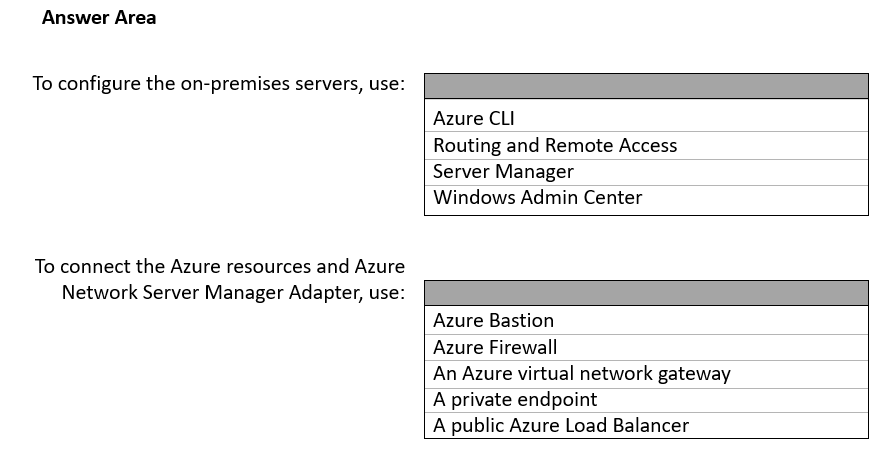
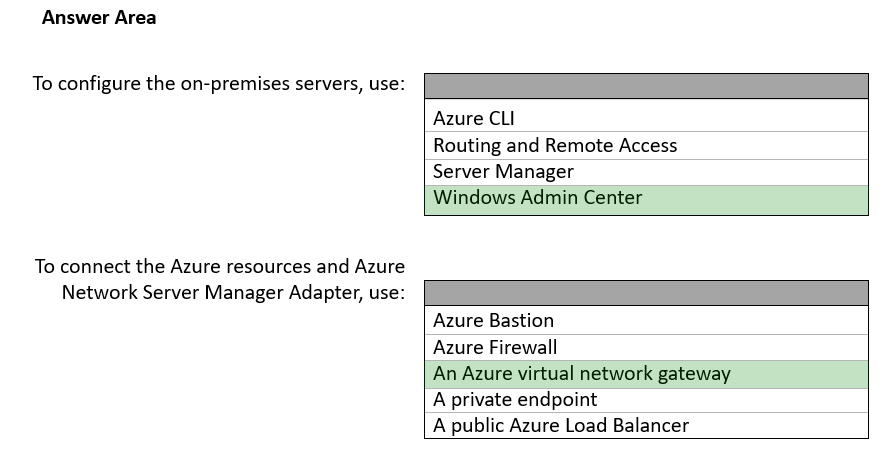
You plan to use Azure Network Adapter to connect the servers to the resources in Azure.
Which prerequisites do you require on-premises and in Azure? To answer, select the appropriate options in the answer area.
NOTE: Each correct selection is worth one point.
Hot Area:
You have 10 on-premises servers that run Windows Server.
You plan to use Azure Network Adapter to connect the servers to the resources in Azure.
Which prerequisites do you require on-premises and in Azure? To answer, select the appropriate options in the answer area.
NOTE: Each correct selection is worth one point.
Hot Area:
Correct Answer:
Reference:
https://docs.microsoft.com/en-us/windows-server/manage/windows-admin-center/azure/use-azure-network-adapter
Reference:
https://docs.microsoft.com/en-us/windows-server/manage/windows-admin-center/azure/use-azure-network-adapter
Question #24
DRAG DROP -
You have a server named Server1 that has Windows Admin Center installed. The certificate used by Windows Admin Center was obtained from a certification authority (CA).
The certificate expires.
You need to replace the certificate.
Which three actions should you perform in sequence? To answer, move the appropriate actions from the list of actions to the answer area and arrange them in the correct order.
Select and Place:
You have a server named Server1 that has Windows Admin Center installed. The certificate used by Windows Admin Center was obtained from a certification authority (CA).
The certificate expires.
You need to replace the certificate.
Which three actions should you perform in sequence? To answer, move the appropriate actions from the list of actions to the answer area and arrange them in the correct order.
Select and Place:
Correct Answer:
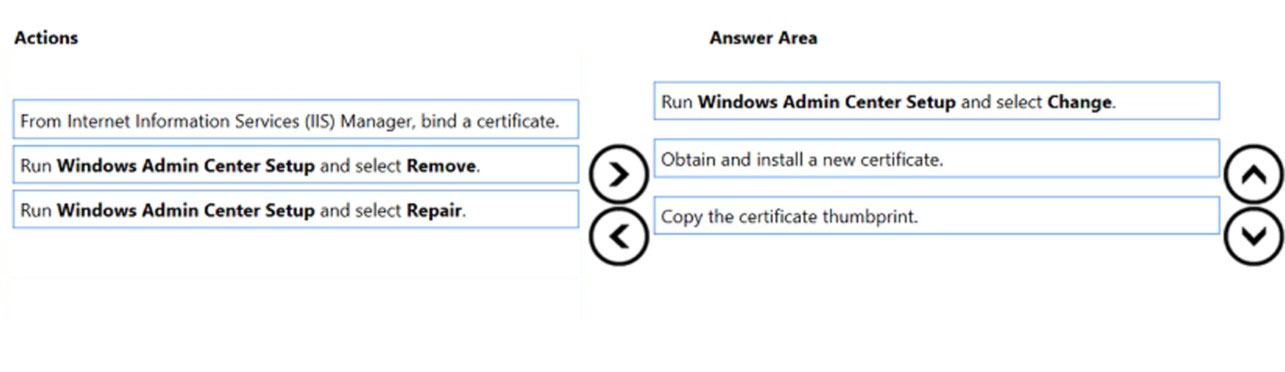
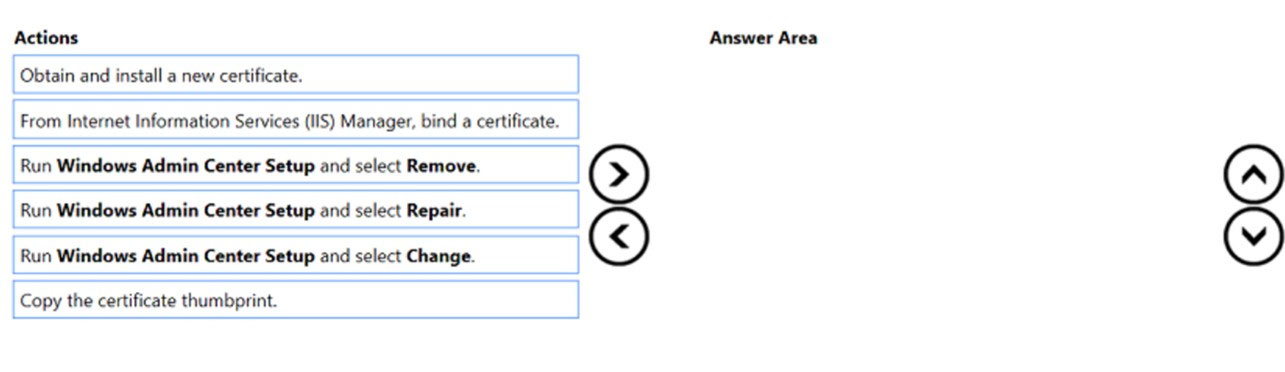
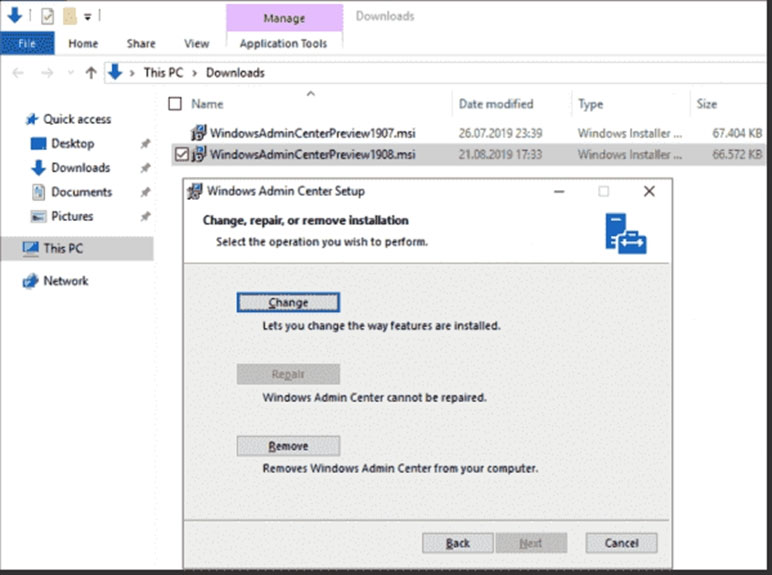
Step 1: Run Windows Admin Center Setup and select Change.
Updating the certificate used by Windows Admin Center
When you have Windows Admin Center deployed as a service, you must provide a certificate for HTTPS. To update this certificate at a later time, re-run the installer and choose change.
Step 2: Obtain and install a new certificate.
Step 3: Copy the certificate thumbprint.
The final step is to copy the certificate's thumbprint into the setup soon after installing it into the local store.
Reference:
https://4sysops.com/archives/install-an-ssl-certificate-in-windows-admin-center/
Step 1: Run Windows Admin Center Setup and select Change.
Updating the certificate used by Windows Admin Center
When you have Windows Admin Center deployed as a service, you must provide a certificate for HTTPS. To update this certificate at a later time, re-run the installer and choose change.
Step 2: Obtain and install a new certificate.
Step 3: Copy the certificate thumbprint.
The final step is to copy the certificate's thumbprint into the setup soon after installing it into the local store.
Reference:
https://4sysops.com/archives/install-an-ssl-certificate-in-windows-admin-center/
Question #25
HOTSPOT -
You have an on-premises server named Server1 that runs Windows Server and has internet connectivity.
You have an Azure subscription.
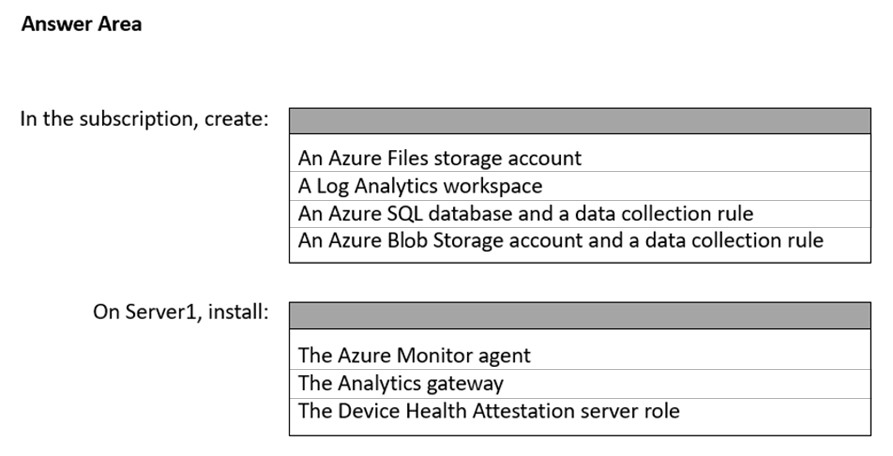
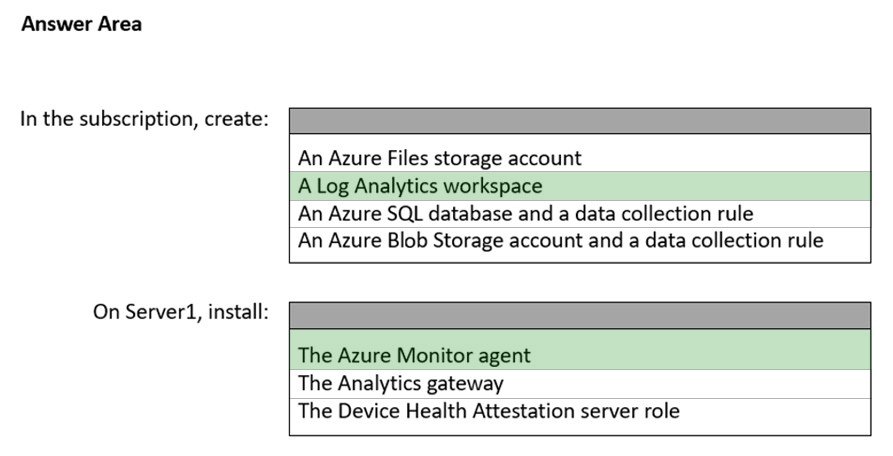
You need to monitor Server1 by using Azure Monitor.
Which resources should you create in the subscription, and what should you install on Server1? To answer, select the appropriate options in the answer area.
NOTE: Each correct selection is worth one point.
Hot Area:
You have an on-premises server named Server1 that runs Windows Server and has internet connectivity.
You have an Azure subscription.
You need to monitor Server1 by using Azure Monitor.
Which resources should you create in the subscription, and what should you install on Server1? To answer, select the appropriate options in the answer area.
NOTE: Each correct selection is worth one point.
Hot Area:
Correct Answer:
Reference:
https://docs.microsoft.com/en-us/windows-server/manage/windows-admin-center/azure/azure-monitor
Reference:
https://docs.microsoft.com/en-us/windows-server/manage/windows-admin-center/azure/azure-monitor
Question #27
HOTSPOT -
Your network contains two Active Directory Domain Services (AD DS) forests named contoso.com and fabrikam.com. A two-way forest trust exists between the forests. Each forest contains a single domain.
The domains contain the servers shown in the following table.

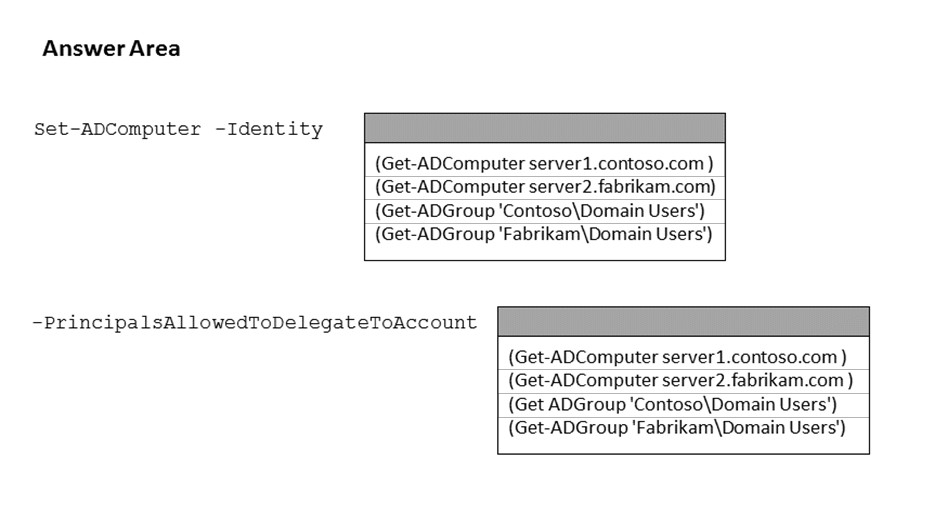
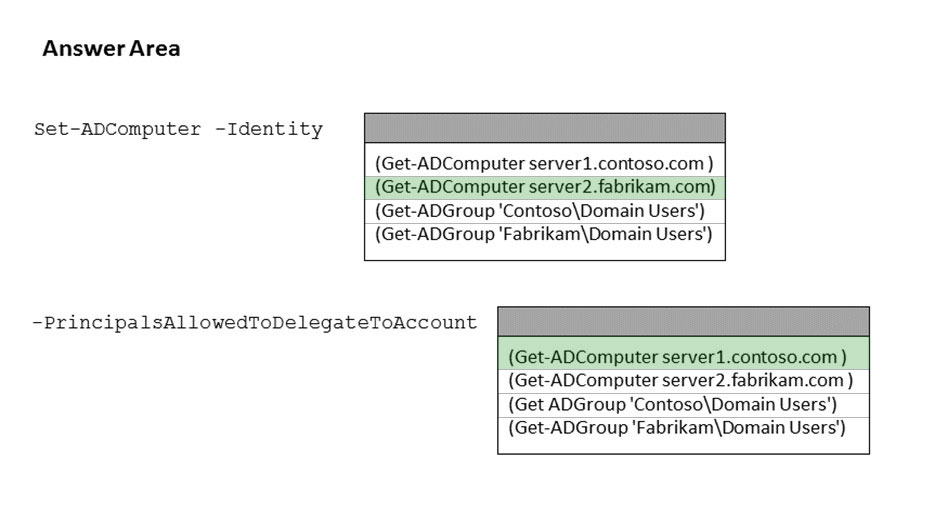
You need to configure resource based constrained delegation so that the users in contoso.com can use Windows Admin Center on Server1 to connect to Server2.
How should you complete the command? To answer, select the appropriate options in the answer area.
NOTE: Each correct selection is worth one point.
Hot Area:
Your network contains two Active Directory Domain Services (AD DS) forests named contoso.com and fabrikam.com. A two-way forest trust exists between the forests. Each forest contains a single domain.
The domains contain the servers shown in the following table.
You need to configure resource based constrained delegation so that the users in contoso.com can use Windows Admin Center on Server1 to connect to Server2.
How should you complete the command? To answer, select the appropriate options in the answer area.
NOTE: Each correct selection is worth one point.
Hot Area:
Correct Answer:
Reference:
https://docs.microsoft.com/en-us/windows-server/security/kerberos/kerberos-constrained-delegation-overview https://docs.microsoft.com/en-us/powershell/module/activedirectory/set-adcomputer?view=windowsserver2022-ps
Reference:
https://docs.microsoft.com/en-us/windows-server/security/kerberos/kerberos-constrained-delegation-overview https://docs.microsoft.com/en-us/powershell/module/activedirectory/set-adcomputer?view=windowsserver2022-ps
Question #28
HOTSPOT -
You have a server named Server1 that runs Windows Server and has the Hyper-V server role installed.
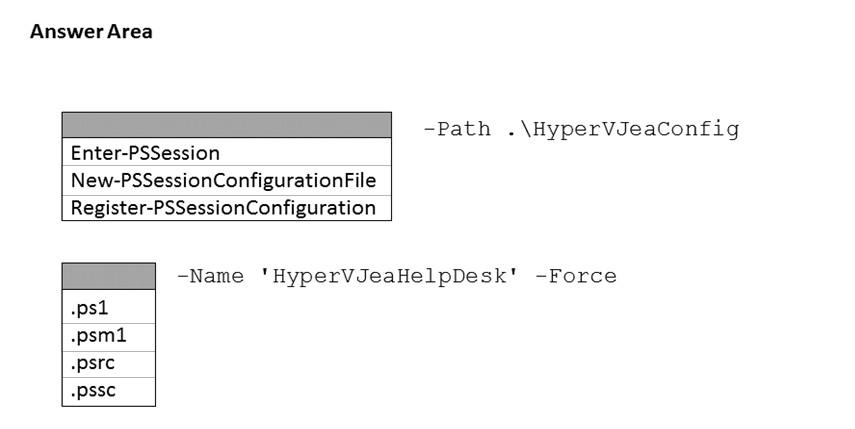
You need to limit which Hyper-V module cmdlets helpdesk users can use when administering Server1 remotely.
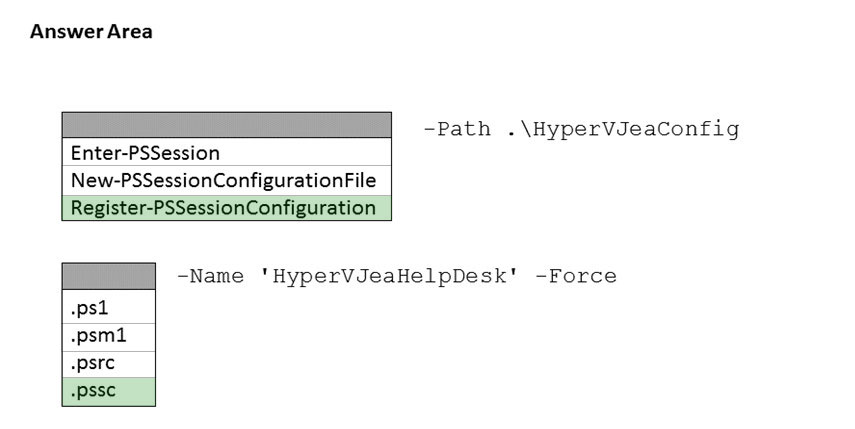
You configure Just Enough Administration (JEA) and successfully build the role capabilities and session configuration files.
How should you complete the PowerShell command? To answer, select the appropriate options in the answer area.
NOTE: Each correct selection is worth one point.
Hot Area:
You have a server named Server1 that runs Windows Server and has the Hyper-V server role installed.
You need to limit which Hyper-V module cmdlets helpdesk users can use when administering Server1 remotely.
You configure Just Enough Administration (JEA) and successfully build the role capabilities and session configuration files.
How should you complete the PowerShell command? To answer, select the appropriate options in the answer area.
NOTE: Each correct selection is worth one point.
Hot Area:
Correct Answer:
Reference:
https://docs.microsoft.com/en-us/powershell/scripting/learn/remoting/jea/register-jea?view=powershell-7.2
Reference:
https://docs.microsoft.com/en-us/powershell/scripting/learn/remoting/jea/register-jea?view=powershell-7.2
Question #30
HOTSPOT -
You have an Azure subscription named sub1 and 500 on-premises virtual machines that run Windows Server.
You plan to onboard the on-premises virtual machines to Azure Arc by running the Azure Arc deployment script.
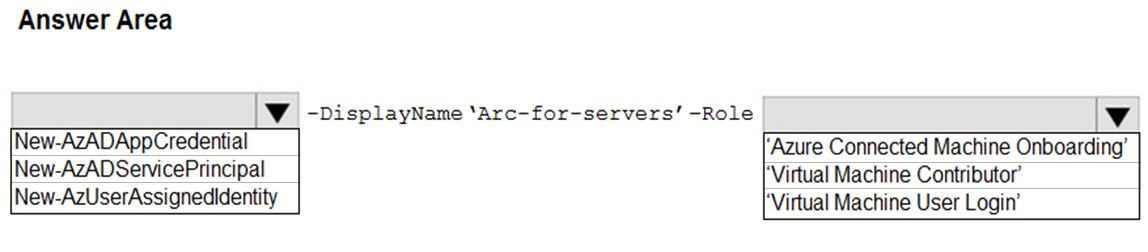
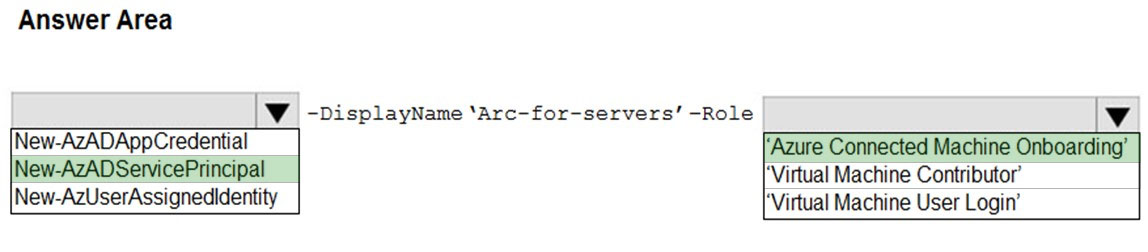
You need to create an identity that will be used by the script to authenticate access to sub1. The solution must use the principle of least privilege.
How should you complete the command? To answer, select the appropriate options in the answer area.
NOTE: Each correct selection is worth one point.
Hot Area:
You have an Azure subscription named sub1 and 500 on-premises virtual machines that run Windows Server.
You plan to onboard the on-premises virtual machines to Azure Arc by running the Azure Arc deployment script.
You need to create an identity that will be used by the script to authenticate access to sub1. The solution must use the principle of least privilege.
How should you complete the command? To answer, select the appropriate options in the answer area.
NOTE: Each correct selection is worth one point.
Hot Area:
Correct Answer:
Reference:
https://docs.microsoft.com/en-us/azure/azure-arc/servers/onboard-service-principal
Reference:
https://docs.microsoft.com/en-us/azure/azure-arc/servers/onboard-service-principal
All Pages