Fortinet FCSS_SDW_AR-7.4 Exam Practice Questions (P. 1)
- Full Access (68 questions)
- One Year of Premium Access
- Access to one million comments
- Seamless ChatGPT Integration
- Ability to download PDF files
- Anki Flashcard files for revision
- No Captcha & No AdSense
- Advanced Exam Configuration
Question #1
Which two statements correctly describe what happens when traffic matches the implicit SD-WAN rule? (Choose two.)
- AThe session information output displays no SD-WAN service id.
- BTraffic is load balanced using the algorithm set for the v4-ecmp-mode setting.
- CFortiGate flags the session with may_dirty and vwl_default.
- DTraffic does not match any of the entries in the policy route table.
- EThe traffic is distributed, regardless of weight, through all available static routes.
send
light_mode
delete
Question #2
Refer to the exhibit.

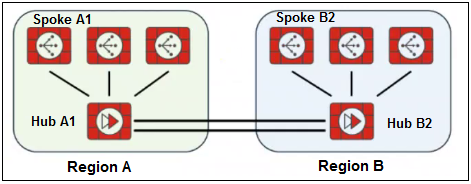
Two hub-and-spoke groups are connected through redundant site-to-site IPsec VPNs between Hub1 and Hub2.
Which two configuration settings are required for the spoke A1 to establish an ADVPN shortcut with the spoke B2? (Choose two.)

Two hub-and-spoke groups are connected through redundant site-to-site IPsec VPNs between Hub1 and Hub2.
Which two configuration settings are required for the spoke A1 to establish an ADVPN shortcut with the spoke B2? (Choose two.)
- AOn hubs, auto-discovery-sender must be enabled on the IPsec VPNs to spokes.
- BOn hubs, auto-discovery-forwarder must be enabled on the IPsec VPNs to hubs.
- COn hubs, auto-discovery-receiver must be enabled on the IPsec VPNs to spokes.
- DOn hubs, auto-discovery-forwarder must be enabled on the IPsec VPNs to spokes.
send
light_mode
delete
Question #3
Refer to the exhibit.

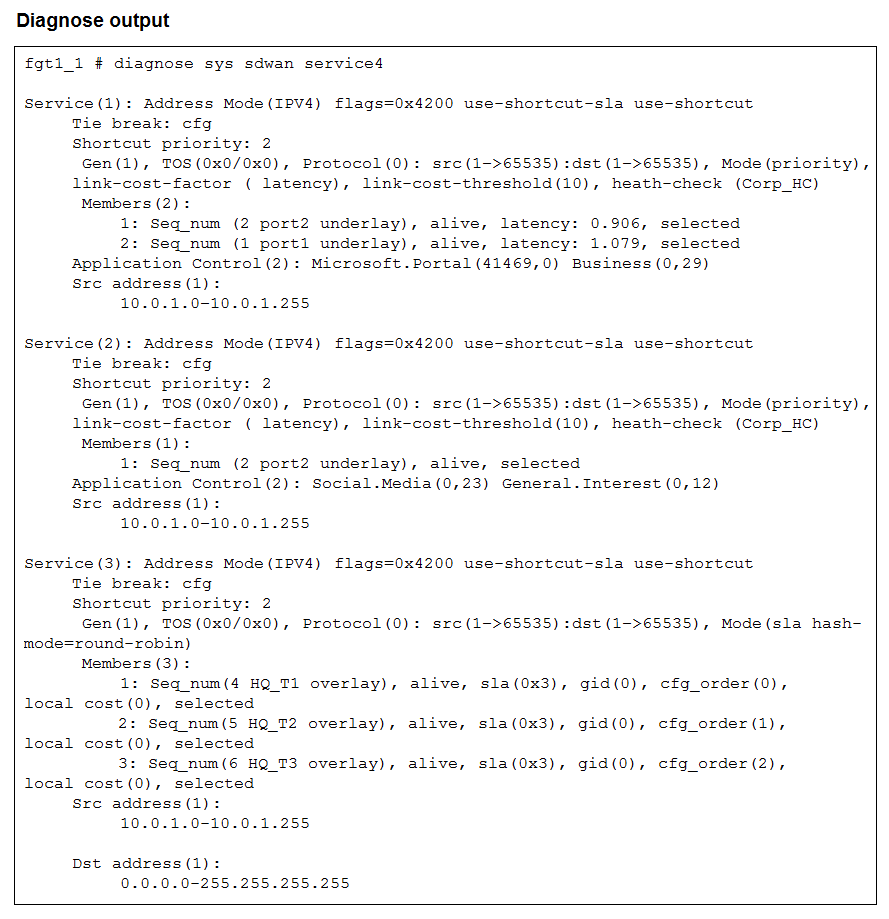
The exhibit shows output of the command diagnose sys sdwan service4 collected on a FortiGate device
The administrator wants to know through which interface FortiGate will steer traffic from local users on subnet 10 0.1.0/255.255.255.192 and with a destination of the social media application Facebook.
Based on the exhibits, which two statements are correct? (Choose two.)

The exhibit shows output of the command diagnose sys sdwan service4 collected on a FortiGate device
The administrator wants to know through which interface FortiGate will steer traffic from local users on subnet 10 0.1.0/255.255.255.192 and with a destination of the social media application Facebook.
Based on the exhibits, which two statements are correct? (Choose two.)
- AFortiGate steers traffic for social media applications according to the service rule 2 and steers traffic through port2.
- BWhen FortiGate cannot recognize the application of the flow, it load balances the traffic through the tunnels HQ_T1, HQ_T2, HQ_T3.
- CThere is no service defined for the Facebook application, so FortiGate appliesservice rule 3 and directs the traffic to headquarters.
- DWhen FortiGate cannot recognize the application of the flow, it steers the traffic through the preferred member of rule 3, HQ_T1.
send
light_mode
delete
Question #4
Refer to the exhibit.

The administrator used the SD-WAN overlay template to prepare an IPsec tunnels configuration for a hub-and-spoke SD-WAN topology. The exhibit shows the FortiManager installation preview for one FortiGate device.
Based on the exhibit, which statement best describes the configuration applied to the FortiGate device?

The administrator used the SD-WAN overlay template to prepare an IPsec tunnels configuration for a hub-and-spoke SD-WAN topology. The exhibit shows the FortiManager installation preview for one FortiGate device.
Based on the exhibit, which statement best describes the configuration applied to the FortiGate device?
- AIt is a spoke device that establishes dynamic IPsec tunnels to the hub. The local subnet range is 10.10 128.0/23.
- BIt is a hub device. It can send ADVPN shortcut offers.
- CIt is a hub device. It will automatically discover the spoke devices and add them to the SD-WAN topology.
- DIt is a spoke device that establishes dynamic IPsec tunnels to the hub. It can send ADVPN shortcut requests.
send
light_mode
delete
Question #5
You are planning a new SD-WAN deployment with the following criteria:
Two regions -
Most of the traffic is expected to remain within its region
No requirement for inter-region ADVPN
To remain within the recommended best practices, which routing protocol should you select for the overlays?
Two regions -
Most of the traffic is expected to remain within its region
No requirement for inter-region ADVPN
To remain within the recommended best practices, which routing protocol should you select for the overlays?
- AIBGP with BGP on loopback within each region and EBGP between the regions.
- BOSPF for the routing within each region and EBGP between the regions.
- CIBGP within each region and between the regions.
- DIBGP with BGP per overlays within each region and IBGP with BGP on loopback between the regions.
send
light_mode
delete
All Pages