
Salesforce Certified MuleSoft Integration Architect I Exam Practice Questions (P. 1)
- Full Access (60 questions)
- One Year of Premium Access
- Access to one million comments
- Seamless ChatGPT Integration
- Ability to download PDF files
- Anki Flashcard files for revision
- No Captcha & No AdSense
- Advanced Exam Configuration
Question #1
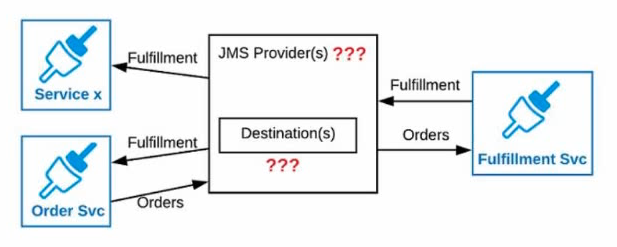
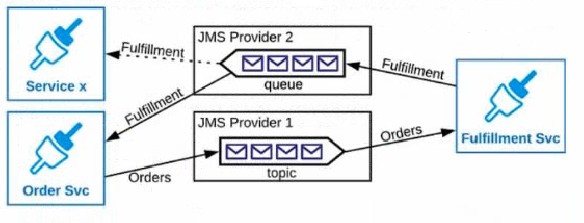
Refer to the exhibits.
An Order microservice and a Fulfillment microservice are being designed to communicate with their clients through message-based integration (and NOT through API invocations).
The Order microservice publishes an Order message (a kind of command message) containing the details of an order to be filled. The intent is that Order messages are only consumed by one Mule application: the Fulfillment microservice.
The Fulfillment microservice consumes Order messages, fills the orders described therein, and then publishes a Fulfillment message (a kind of event message). Each Fulfillment message can be consumed by any interested Mule application, and the Order microservice is one such Mule application.
What is the recommended choice of message broker(s) and message destination(s) in this scenario?
An Order microservice and a Fulfillment microservice are being designed to communicate with their clients through message-based integration (and NOT through API invocations).
The Order microservice publishes an Order message (a kind of command message) containing the details of an order to be filled. The intent is that Order messages are only consumed by one Mule application: the Fulfillment microservice.
The Fulfillment microservice consumes Order messages, fills the orders described therein, and then publishes a Fulfillment message (a kind of event message). Each Fulfillment message can be consumed by any interested Mule application, and the Order microservice is one such Mule application.
What is the recommended choice of message broker(s) and message destination(s) in this scenario?
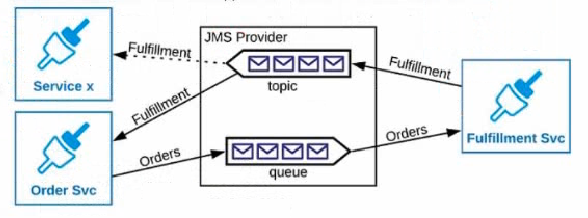
- AOrder messages are sent to a JMS queue.
Fulfillment messages are sent to a JMS topic.
Both microservices interact with the same JMS provider (message broker) instance, which must therefore scale to support the load of both microservices.
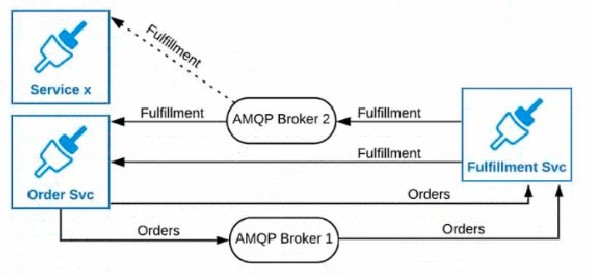
- BOrder messages are sent directly to the Fulfillment microservice.
Fulfillment messages are sent directly to the Order microservice.
The order microservice interacts with one Advanced Message Queuing Protocol (AMQP)- compatible message broker and the Fulfillment microservice interacts with a different AMQP-compatible message broker so that both message brokers can be chosen and scaled to best support redelivery to each microservice and future auditing and integrations.
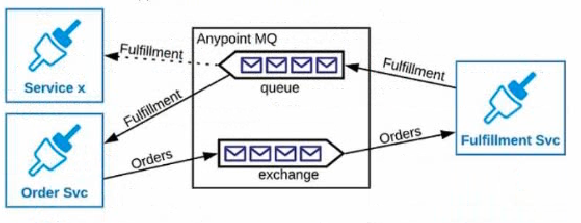
- COrder messages are sent to an Anypoint MQ exchange.
Fulfillment messages are sent to an Anypoint MQ queue.
Both microservices interact with Anpoint MQ as the message broker, which must therefore scale to support the load of both microservices.
- DOrder messages are sent to a JMS topic.
Fulfillment messages are sent to a JMS queue.
The Order microservice interacts with one JMS provider (message broker) and the Fulfillment microservice interacts with a different JMS provider so that both message brokers can be chosen and scaled to best support the load of each microservice.
send
light_mode
delete
Question #2
Why would an Enterprise Architect use a single enterprise-wide canonical data model (CDM) when designing an integration solution using Anypoint Platform?
- ATo reduce dependencies when integrating multiple systems that use different data formats
- BTo remove the need to perform data transformation when processing message payloads in Mule applications
- CTo leverage a data abstraction layer that shields existing Mule applications from non-backward compatible changes to the model’s data structure
- DTo automate AI-enabled API implementation generation based on normalized backend databases from separate vendors
send
light_mode
delete
Question #3
An application deployed in CloudHub production environment is throwing intermittent exceptions. To troubleshoot the issue, a developer wants to enable DEBUG level logging in production for the org.apache.cxf package in the deployment Mule application.
How should the developer update the logging configuration in order to enable this package specific debugging?
- AIn the Mule application’s log4j2.xml file, change the root logger’s level property to DEBUG, then redeploy the Mule application to the CloudHub production environment
- BIn Anypoint Runtime Manager, in the Deployed Application Properties tab for the Mule application, add a line item with DEBUG level for package org.apache.cxf and apply the changes
- CIn the Mule application’s log4j2.xml file, add an AsyncLogger element with name property set to org.apache.cxf and level set to DEBUG, then redeploy the Mule application in the CloudHub production environment
- DIn Anypoint Monitoring, define a logging search query with class property set to org.apache.cxf and level set to DEBUG
send
light_mode
delete
Question #4
Following MuleSoft’s recommended best practices for API governance and API policies, a project team has used RAML specifications to document and publish functional requirements and detailed design definitions of its APIs. These API specifications have been used by various stakeholders to implement APIs.
Later, the project team requires all API specifications to be augmented with an additional non-functional requirement (NFR) to protect the backend services from a high rate of requests, according to defined service-level agreements (SLAs). The NFR’s SLAs are based on a new tiered subscription level “Gold”, “Silver”, or “Platinum” that must be tied to a new parameter that is being added to the Accounts object in their enterprise data model.
Following MuleSoft’s recommended best practices, how should the project team now convey the necessary non-functional requirement to stakeholders?
Later, the project team requires all API specifications to be augmented with an additional non-functional requirement (NFR) to protect the backend services from a high rate of requests, according to defined service-level agreements (SLAs). The NFR’s SLAs are based on a new tiered subscription level “Gold”, “Silver”, or “Platinum” that must be tied to a new parameter that is being added to the Accounts object in their enterprise data model.
Following MuleSoft’s recommended best practices, how should the project team now convey the necessary non-functional requirement to stakeholders?
- ACreate a shared RAML fragment required to implement the NFR, list each API implementation endpoint in the RAML fragment, and publish the RAML fragment to Exchange
- BCreate and deploy API proxies in API Manager for the NFR, change the baseUrl in each API specification to the corresponding API proxy implementation endpoint, and publish each modified API specification to Exchange
- CUpdate each API specification with comments about the NFR’s SLAs and publish each modified API specification to Exchange
- DUpdate each API specification with a shared RAML fragment required to implement the NFR and publish the RAML fragment and each modified API specification to Exchange
send
light_mode
delete
Question #5
How does a timeout attribute in a configured transaction manager help inform design decisions while using a JMS connector listening for incoming messages in an eXtended Architecture (XA) transaction managed by the transaction manager?
- AThe timeout specifies the time allowed to pass between receiving JMS messages on the same JMS connection, and then after the timeout, a new JMS connection is established
- BThe time allowed to pass between committing the transaction and the completion of the Mule flow, and then after the timeout, flow processing triggers an error
- CAfter the timeout is exceeded, stale JMS consumer threads are destroyed and new threads are created
- DThe timeout defines the time that is allowed to pass without the transaction ending explicitly, and after the timeout expires, the transaction rolls back
send
light_mode
delete
All Pages
