


Cisco® 300-430 Exam Practice Questions (P. 1)
- Full Access (326 questions)
- One Year of Premium Access
- Access to one million comments
- Seamless ChatGPT Integration
- Ability to download PDF files
- Anki Flashcard files for revision
- No Captcha & No AdSense
- Advanced Exam Configuration
Question #1
On a branch office deployment, it has been noted that if the FlexConnect AP is in standalone mode and loses connection to the WLC, all clients are disconnected, and the SSID is no longer advertised. Considering that FlexConnect local switching is enabled, which setting is causing this behavior?
- AISE NAC is enabled
- B802.11r Fast Transition is enabled
- CClient Exclusion is enabled
- DFlexConnect Local Auth is disabled
Correct Answer:
A
 GPT
GPT
The FlexConnect AP in standalone mode disconnects clients and ceases SSID advertisement due to disabled local authentication (Local Auth). When Local Auth is disabled, the AP lacks the ability to authenticate clients independently of the WLC, making it dependent on WLC connectivity for client authentication and maintaining active sessions. If the connection to the WLC is disrupted, this setup immediately affects user connectivity and SSID visibility because the AP can no longer verify the credentials of clients or accept new connections. Thus, enabling Local Auth would allow the AP to continue servicing clients independent of the WLC's state.
Question #2
An engineer must implement intrusion protection on the WLAN. The AP coverage is adequate and on-channel attacks are the primary concern. The building is historic, which makes adding APs difficult. Which AP mode and submode must be implemented?
- AAP mode: local, AP submode: none
- BAP mode: monitor, AP submode: WIPS
- CAP mode: monitor, AP submode: none
- DAP mode: local, AP submode: WIPS
Correct Answer:
D
D
GPT
Absolutely, choice D is the top pick here. When dealing with on-channel attacks specifically, maintaining the AP in local mode ensures the continuous serving of clients while incorporating WIPS offers the necessary protection against intrusions. Switching fully to monitor mode would've indeed led to issues such as coverage holes, which isn’t a breeze to fix, especially within a historic building. Thus striking this balance by keeping the access point in local mode with the WIPS submode is both effective and pragmatic. No need to sacrifice connectivity for security!
Question #3
An engineer is implementing a FlexConnect group for access points at a remote location using local switching but central DHCP. Which client feature becomes available only if this configuration is changed?
- Amulticast
- Bstatic IP
- Cfast roaming
- DmDNS
Correct Answer:
B
B
GPT
The correct implementation of a FlexConnect group with local switching and central DHCP does indeed prevent the use of clients with static IP addresses. When configuring such settings, the system enforces the use of a DHCP server to dynamically assign IP addresses, precluding the manual setting of static IPs. Allowing static IPs would necessitate a change in this configuration, possibly by involving different methods of IP address assignment at the remote locations. This clarifies why option B is correct.
Question #4
A FlexConnect remote office deployment is using five 2702i APs indoors and two 1532i APs outdoors. When a code upgrade is performed and FlexConnect Smart
AP Image Upgrade is leveraged, but no FlexConnect Master AP has been configured, how many image transfers between the WLC and APs will occur?
AP Image Upgrade is leveraged, but no FlexConnect Master AP has been configured, how many image transfers between the WLC and APs will occur?
- A1
- B2
- C5
- D7
Correct Answer:
B
B
GPT
When using FlexConnect Smart AP Image Upgrade without a designated FlexConnect Master AP, the system automatically selects one AP per model based on the lowest MAC address to serve as a primary AP. This means, in our case with two different AP models (2702i and 1532i), one AP from each model will download the image from the WLC, resulting in two image transfers in total. This efficient method distributes the upgrade process, ensuring minimal bandwidth usage and streamlined management.
Question #6
When configuring a Cisco WLC, which CLI command adds a VLAN with VLAN ID of 30 to a FlexConnect group named BranchA-FCG?
- Aconfig flexconnect BranchA-FCG vlan 30 add
- Bconfig flexconnect BranchA-FCG vlan add 30
- Cconfig flexconnect group BranchA-FCG vlan 30 add
- Dconfig flexconnect group BranchA-FCG vlan add 30
Correct Answer:
D
D
GPT
Absolutely spot-on with choice D! The command 'config flexconnect group BranchA-FCG vlan add 30' precisely does the job of adding VLAN 30 to the FlexConnect group named BranchA-FCG. This format is consistent with Cisco's configuration guidelines for Wireless LAN Controllers, ensuring proper syntax and sequence in the command structure for adding VLANs to FlexConnect groups. Always double-check such commands against the latest documentation or your configuration settings to ensure accuracy and compatibility. Keep up the good work!
Question #7
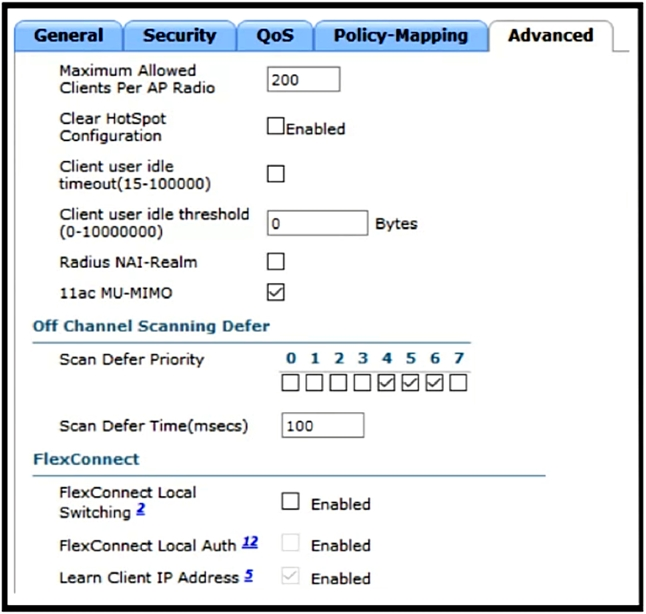
Refer to the exhibit. A customer has implemented Cisco FlexConnect deployments with different WLANs around the globe and is opening a new branch in a different location. The engineer's task is to execute all the wireless configuration and to suggest how to configure the switch ports for new APs. Which configuration must the switching team use on the switch port?
Question #8
A corporation is spread across different countries and uses MPLS to connect the offices. The senior management wants to utilize the wireless network for all the employees. To ensure strong connectivity and minimize delays, an engineer needs to control the amount of traffic that is traversing between the APs and the central WLC. Which configuration should be used to accomplish this goal?
- AFlexConnect mode with central switching enabled
- BFlexConnect mode with central authentication
- CFlexConnect mode with OfficeExtend enabled
- DFlexConnect mode with local authentication
Correct Answer:
D
D
GPT
FlexConnect with local authentication is indeed the fitting solution here. This feature allows APs to handle client authentication locally. This significantly reduces the back-and-forth traffic between APs and the central WLC, crucial for offices spread across different countries connected by MPLS. Local processing of authentication reduces delay, enhances performance, and ensures that even if the WAN link to the WLC is down, users can still connect to the network, maintaining productivity and connectivity integrity.
Question #10
An engineer must configure a Cisco WLC to support Cisco Aironet 600 Series OfficeExtend APs. Which two Layer 2 security options are supported in this environment? (Choose two.)
- AStatic WEP + 802.1X
- BWPA+WPA2
- CStatic WEP
- DCKIP
- E802.1X
Correct Answer:
BE
GPT
In setting up Cisco Aironet 600 Series OfficeExtend APs for Layer 2 security, two options available are WPA+WPA2 and Static WEP. Note, however, that Static WEP should not be used if running .11n data rates. This consideration is crucial for maintaining compliance with the supported security configurations while ensuring optimal performance for different data rates supported by the APs.
All Pages